
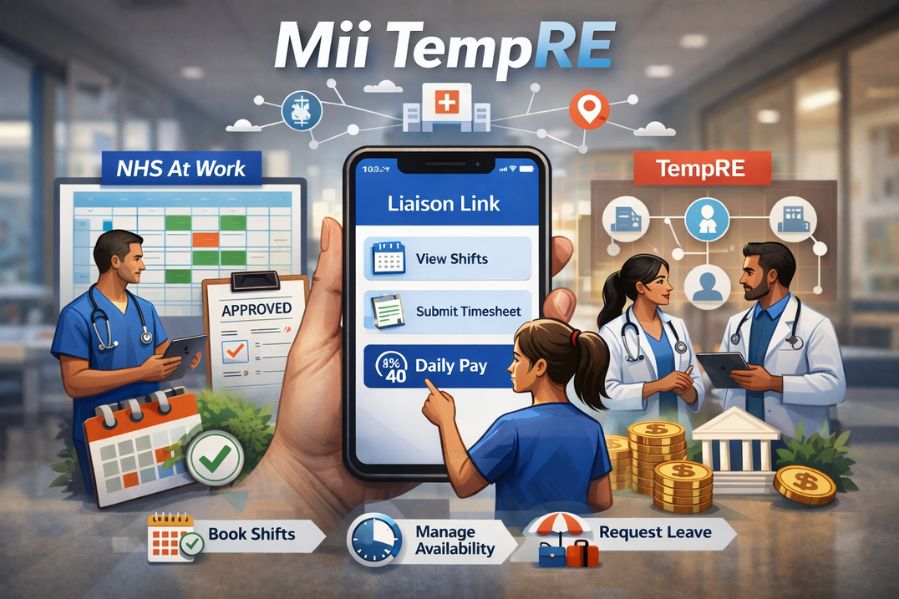

In today’s healthcare environment, speed, flexibility, and visibility are essential. Both NHS organisations and temporary workers need systems that cut admin and simplify scheduling to streamline workforce management. Mii TempRE is now a key search term and discussion point, commonly linked to Liaison Group’s workforce tools for healthcare professionals—especially the mobile experience. Although some still call the app mii Account, official materials now categorise the mobile tool as Liaison Link, which connects to TempRE and NHS At Work rostering via single sign-on.
Mii TempRE attracts attention because it addresses two major needs in modern healthcare staffing. Temporary staff require mobile-friendly tools to check shifts, submit timesheets, manage availability, and access pay details. NHS organisations seek better control over staffing costs, stronger governance, easier collaboration with staff banks, and fewer delays in filling shifts. Liaison Group positions TempRE as a workforce management solution for these needs, with its companion mobile app enabling healthcare workers to act on the move.
What Mii TempRE Actually Refers To
When people search for Mii TempRE, they are usually looking to clarify how three related elements connect: the historical Mii Account identity, the TempRE workforce platform, and the more recent Liaison Link app branding. Official app store listings and Liaison Group pages now show users the Liaison Link mobile app, which gives access to Liaison Workforce solutions—including TempRE and NHS At Work—via single sign-on. Thus, while ‘Mii TempRE’ remains relevant in search and discussion, the visible product language has shifted to ‘Liaison Link’ rather than relying on the old Mii Account name.
This distinction matters because it clarifies branding changes and avoids confusion. Older brochures or online mentions may describe the Mii Account as the app supporting NHS workers, whereas recent official pages refer to Liaison Link in a similar role. Despite the name transition, the underlying purpose remains consistent: it serves as a mobile entry point for healthcare professionals to manage work activities, connect with staffing services, and access tools linked to TempRE. The phrase Mii TempRE, therefore, is best understood as a practical shorthand for the app-and-platform combination that supports temporary staffing workflows in NHS settings.
Core Features That Make Mii TempRE Useful for NHS Workers
One of the strongest aspects of Mii TempRE is convenience. Official descriptions say the app experience enables healthcare professionals to manage key aspects of their daily NHS work from a mobile device. TempRE users can search and apply for shifts, submit timesheets, and set unavailability while on the move. For users with access to NHS At Work rostering, the same app also supports viewing schedules, requesting leave, and managing shift swaps. That combination is important because it reduces the need to jump between multiple systems for common actions.
This is particularly valuable for temporary staff, bank workers, and locums whose work patterns can change quickly. A mobile-first system helps workers respond faster to shift opportunities, keep track of confirmed bookings, and complete timesheet submission without waiting until they return to a computer. In busy healthcare environments, that kind of responsiveness can improve both worker experience and operational efficiency. Instead of relying on fragmented communication or paper-based processes, staff can use a single central workflow for visibility and action. That is why Mii TempRE is often seen as more than just a scheduling tool. It functions as a work-life management app for healthcare professionals who need flexibility, speed, and reliable access to information.
How TempRE Supports Workforce Management Behind the Scenes
Although workers first notice the mobile side, TempRE is a comprehensive workforce management solution. Liaison Group describes it as helping control staffing costs and supporting organisational collaboration. Available on desktop and mobile, with open APIs, Mii TempRE serves both individual workers and broader workforce strategies.
For NHS employers, this matters because temporary staffing is often one of the most operationally sensitive and financially pressured areas of workforce management. A platform like TempRE is designed to support vacancy release, onboarding, timesheets, payments, and bank staff activity in a more structured way. Liaison Group’s TempRE Staff Bank material also highlights functionality around promoting and attracting NHS staff, handling onboarding and payments, and releasing additional bank shifts based on role-related factors such as grade, band, or clinical speciality. This suggests that Mii TempRE fits into a full operational pipeline, not just a limited front-end booking system.
Daily Pay and Why It Stands Out
A major reason Mii TempRE is discussed so frequently is the Daily Pay feature. Official support information states that eligible workers may request up to 40% of earned pay, excluding expenses, once a timesheet has been submitted and authorised. The same support materials note that requests can be processed within about two hours when conditions are met, and Daily Pay is then deducted from the weekly payroll later. That feature gives temporary workers quicker access to money already earned, which can be especially meaningful for people managing variable schedules and irregular cash flow.
Daily Pay offers more than convenience—it supports financial flexibility and reduces stress for workers needing timely income. Liaison Group presents it as part of a weekly payroll service for staff wellbeing and retention. This shows Mii TempRE aims to enhance the worker experience alongside operational support.
Availability, Leave, and Shift Control in One Place
Another reason the Mii TempRE concept resonates with NHS workers is that it consolidates several routine work controls into a single mobile environment. Official app descriptions say TempRE users can set unavailability, while users with rostering access can also request leave and manage shift swaps. These features matter because workforce flexibility only works well when staff can quickly show when they are free, unavailable, or looking to adjust planned work.
From a worker’s perspective, this makes day-to-day planning easier. Instead of emailing multiple departments or chasing managers to communicate changes, staff can use app-based tools to keep their status up to date. From an organisational perspective, better visibility into availability supports better fill rates, fewer scheduling gaps, and less manual administration. In a sector where staffing needs can change quickly, that level of responsiveness has clear value. It also reinforces why Mii TempRE should be viewed as a workflow platform rather than just a shift booking app. It combines schedule access, timesheet submission, availability management, leave coordination, and shift exchange into a single connected experience.
Access, Login, and Platform Availability
From an accessibility standpoint, the official information indicates that the app is available on major mobile platforms. Current listings show Liaison Link on both the Apple App Store and Google Play, and the descriptions on those stores explain that the app provides access to TempRE and related services using single sign-on. TempRE also has its own support documentation for logging in through the web platform, showing that the wider system is available beyond mobile alone.
Different users interact with workforce tools in various ways. Some rely on the app for tasks; managers may prefer a desktop. TempRE’s accessibility on both platforms supports mixed working environments. For Mii TempRE searches, the takeaway is centralised, practical access to multiple workforce functions with one sign-on.
Why Mii TempRE Matters in Modern Healthcare Staffing
Healthcare staffing pressures are unlikely to disappear, which is exactly why a term like Mii TempRE remains relevant. It represents a move toward connected workforce systems that serve both organisational and worker needs. On one side, NHS organisations need better staffing control, improved collaboration, more transparent bank management, and tighter cost oversight. On the other side, workers need an easier way to view shifts, submit timesheets, manage time off, and track pay. TempRE and its associated mobile app experience sit in the middle of those needs.
The greatest value of Mii TempRE is that it unifies multiple disconnected processes into a single practical system. That may sound simple, but in real-world workforce operations, it can make a major difference. Systems that reduce friction tend to improve adoption, and systems that improve adoption often lead to better operational consistency. For healthcare professionals under pressure, a reliable app can help reduce administrative burden and improve confidence in their ability to manage work tasks quickly. For employers, that same app can support smoother workforce coordination and stronger governance over temporary staffing.
Conclusion
Mii TempRE is best understood as the practical combination of Liaison Group’s mobile workforce app experience and the TempRE staffing platform used in NHS settings. Although current branding points more clearly to Liaison Link, the core idea remains the same: a connected system that allows temporary healthcare workers to handle shifts, timesheets, availability, leave, and pay elements in one place. It also supports broader workforce management goals for healthcare organisations, particularly in staffing control, efficiency, and collaboration.
For anyone researching Mii TempRE, the most useful takeaway is that this is not just an app name or a simple scheduling tool. It is part of a broader workforce ecosystem built to support both NHS workers and healthcare employers. Its value lies in mobility, integration, and practical everyday use. Features such as single sign-on, shift search, timesheet submission, availability management, and Daily Pay help explain why the term continues to attract interest and why the platform remains relevant in discussions about modern healthcare staffing.