
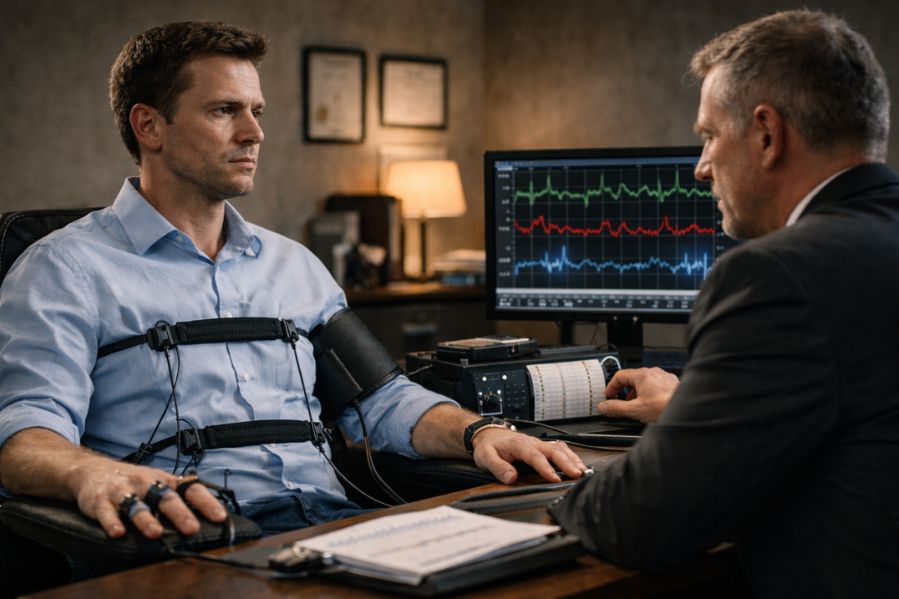

A polygraph test has a certain reputation. You picture someone in a quiet room, wires attached, a serious examiner asking loaded questions. It feels almost cinematic—like truth itself is about to be pulled out of a person, whether they like it or not.
But here’s the thing. A polygraph doesn’t actually detect lies.
That alone surprises most people.
What it does instead—and how that gets interpreted—is where things get interesting, messy, and sometimes controversial.
Let’s unpack it in a way that actually makes sense.
What a Polygraph Test Is Really Doing
At its core, a polygraph measures physical reactions. That’s it.
When you’re hooked up to one, it tracks things like your heart rate, breathing patterns, blood pressure, and skin conductivity (basically, how much you’re sweating). These are all controlled by your autonomic nervous system—the part of your body that reacts automatically when you’re stressed or anxious.
So if you get nervous, your body shows it.
The assumption behind the test is simple: people get more nervous when they lie than when they tell the truth.
Sounds reasonable, right?
But human behavior isn’t that clean.
Imagine someone who’s terrified of being falsely accused. Even if they’re completely innocent, their body might react strongly to certain questions. On the flip side, someone who’s calm under pressure—or used to lying—might show very little change.
That’s where things start to blur.
A Quick Walkthrough of How It Works
You walk into the room. It’s usually quiet, controlled, a bit sterile. The examiner explains the process, attaches sensors to your chest, fingers, and arm.
Before the actual test begins, there’s a “pre-test” phase. This is more important than most people realize.
The examiner talks through the questions with you. Not casually—very deliberately. They want to establish a baseline and make sure you understand exactly what’s being asked.
Then come three types of questions:
- Neutral ones (“Is your name John?”)
- Control questions (designed to provoke a mild stress response)
- Relevant questions (the ones tied to the issue being investigated)
Your responses to these are compared.
If your body reacts more strongly to the relevant questions than the control ones, that’s interpreted as deception.
At least, that’s the theory.
Where It Gets Complicated
Here’s the part people don’t talk about enough: the results aren’t as objective as they sound.
The data—heart rate spikes, breathing changes—gets interpreted by a human examiner. And humans bring judgment, experience, and sometimes bias into the equation.
Two examiners could look at the same charts and come to slightly different conclusions.
And then there’s the psychological layer.
Let’s say someone is naturally anxious. Or they’ve had a bad experience with authority. Or they’re just sitting there thinking, “What if I fail this even though I’m telling the truth?”
That anxiety can show up as a “deceptive” pattern.
Now flip it. Someone who feels confident, detached, or even manipulative might stay calm enough to pass.
So the test ends up measuring something real—physiological arousal—but connecting that directly to lying? That’s a leap.
Why Polygraph Tests Are Still Used
Given all that, you’d expect polygraphs to be obsolete.
But they’re not.
They’re still used in law enforcement, government security screenings, and even in some private employment situations.
Why?
Part of it is psychological pressure.
When someone believes a machine can detect lies, they’re more likely to confess before or during the test. The setup itself can be intimidating enough to encourage honesty—or at least more disclosure.
There’s also a practical angle. Investigators don’t rely on polygraphs alone. They use them as one tool among many.
Think of it less like a lie detector and more like a conversation amplifier. It can highlight areas worth digging into, even if it doesn’t prove anything on its own.
A Real-Life Style Scenario
Picture this.
Someone applies for a job that requires a high level of trust—say, a government position. As part of the screening, they take a polygraph test.
They’ve never done anything illegal. They’re honest. But they’re also nervous. Really nervous.
During the test, one question hits a sensitive nerve—not because they’re guilty, but because it reminds them of something uncomfortable from years ago. Their heart rate jumps. Breathing shifts.
The examiner notices.
Later, that reaction becomes a point of concern.
Now imagine how frustrating that would feel. You told the truth, but your body didn’t cooperate in the way the test expected.
That’s not a rare situation.
Can People Beat a Polygraph?
Short answer: sometimes.
Longer answer: it’s not as simple as people think, but it’s not impossible either.
There are known techniques—controlling breathing, subtly tensing muscles, even altering mental focus during control questions. These can affect the baseline readings and make it harder to distinguish “truth” from “deception.”
Some people try to game the system by staying calm overall. Others intentionally create stress during control questions to balance out their reactions.
Examiners are trained to spot these attempts. But again, this isn’t foolproof.
The fact that “beating” a polygraph is even a topic tells you something important: the system isn’t airtight.
Are Polygraph Results Admissible in Court?
In most places, no—or at least not easily.
Courts tend to be cautious about polygraph evidence because of the reliability issues. The scientific community itself is divided on how accurate these tests really are.
Some jurisdictions allow polygraph results if both sides agree to it beforehand. Others reject them outright.
That says a lot.
If something were truly a clear-cut lie detector, it would be standard courtroom evidence. The hesitation reflects the underlying uncertainty.
The Accuracy Debate
You’ll see wildly different numbers thrown around—some claim polygraphs are over 90% accurate, others argue they’re barely better than chance.
The truth sits somewhere in the middle.
Accuracy depends on the examiner’s skill, the testing method, and the individual being tested. Even in ideal conditions, there’s still a margin of error.
And that margin matters.
Because when the stakes are high—jobs, reputations, legal outcomes—even a small chance of being wrong can have serious consequences.
The Human Factor
Let’s step back for a second.
At its heart, a polygraph test is built on a simple idea: your body betrays you when you’re not telling the truth.
That’s appealing. Almost comforting. It suggests there’s a way to cut through lies and get to the facts.
But humans aren’t that predictable.
We get nervous for all kinds of reasons. We stay calm for unexpected ones. Emotions, memories, stress, personality—they all mix together in ways that don’t fit neatly into a chart.
So the polygraph ends up reflecting something real—your internal state in that moment—but not necessarily the thing it’s trying to measure.
When It Can Be Useful
Despite its limitations, the polygraph isn’t useless.
In the right context, it can be helpful.
It can encourage honesty during investigations. It can help narrow down areas that need more attention. It can even give insight into how someone is reacting emotionally to certain topics.
But it works best when it’s treated as one piece of a larger puzzle.
Relying on it as a definitive answer? That’s where problems start.
The Psychological Weight of the Test
There’s also something worth saying about the experience itself.
Sitting in that chair, connected to sensors, being asked direct, sometimes uncomfortable questions—it creates pressure. Even if you know you’ve done nothing wrong, it doesn’t always feel that way.
People often walk into a polygraph test thinking, “What if I fail?”
That fear alone can shape the outcome.
And once the test is over, the result—whether accurate or not—can stick with you. It can influence how others see you, and sometimes how you see yourself.
That’s a heavy burden for a tool that isn’t fully reliable.
So, Should You Trust a Polygraph?
Here’s the honest answer: trust it cautiously.
Understand what it measures. Respect its limitations. Don’t treat it like a magic truth machine.
If you ever find yourself taking one, the best approach is simple—answer honestly, stay as calm as you can, and don’t overthink every question.
Easier said than done, of course.
But remember, the test isn’t reading your mind. It’s reading your body.
And your body doesn’t always tell a clear story.
Final Thoughts
The polygraph test sits in an odd space between science and psychology. It’s not fake, but it’s not definitive either.
It captures something real—your physiological response in a moment of pressure—but translating that into truth or deception is where things get complicated.
That gap between what it measures and what people think it measures is where most of the confusion lives.
So next time you hear “lie detector,” take it with a grain of salt.
Because the truth, as it turns out, is a lot harder to measure than a heartbeat.