
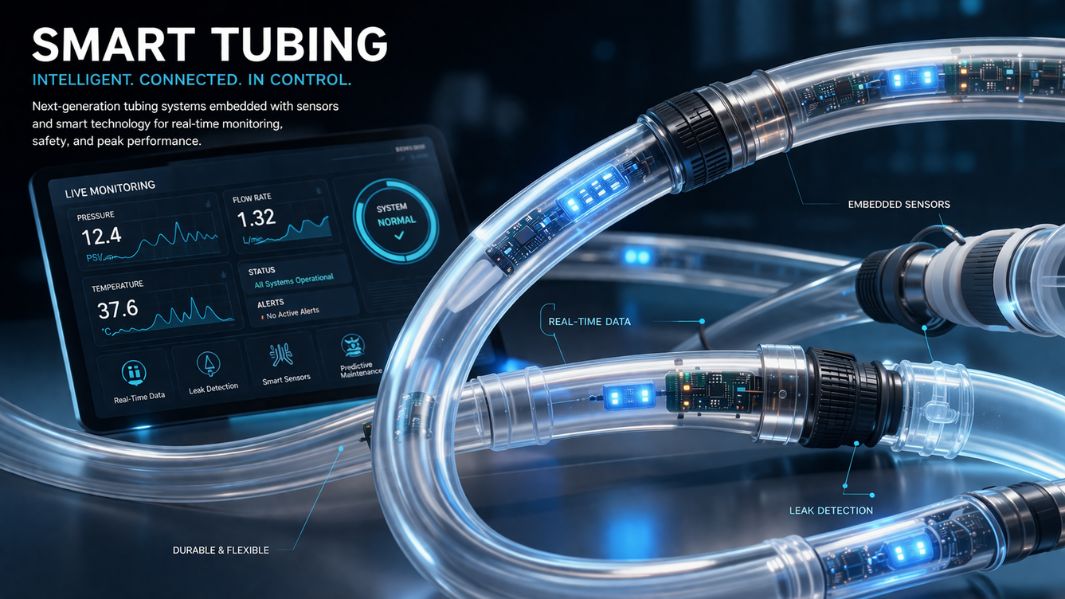

Smart Tubing marks a significant evolution in how modern industries use tubing. While traditional tubing simply transports materials, today’s industries require more real-time data, greater safety, and system efficiency. Smart Tubing transforms tubing from a passive channel into an active system component, supporting monitoring, control, and early response to changes. This advancement improves product quality, reduces waste, supports patient safety, and helps operators keep systems running smoothly. As technology integrates with infrastructure, Smart Tubing exemplifies how ordinary components become far more valuable.
What Smart Tubing Really Means
At its core, Smart Tubing refers to tubing systems that go beyond basic transport by incorporating features that allow them to measure, communicate, respond, or verify conditions during use. This can include embedded sensors (devices to detect and report physical quantities), data-tracking functions (systems to record usage information), intelligent connectors (automated plugs or joints), pressure monitoring (continuous measurement of internal force), temperature detection (tracking heat or cold), flow measurement (monitoring fluid movement), or material properties engineered for performance and feedback (materials designed for strength, cleanliness, or responsiveness). In some industries, the “smart” element may come from electronics integrated into the tubing wall or connector assembly. In others, it may come from digital compatibility (the ability to interface with computers or larger monitoring systems). The exact form can vary, but the principle stays the same: the tubing does more than carry material. It also helps users understand what is happening inside the system. That intelligence can be extremely valuable in environments where a small mistake or unnoticed change can create larger problems. Smart Tubing, therefore, represents a move from passive infrastructure (just conveying substances) to active system participation (contributing information or control), and that shift is why it is attracting attention in such a wide variety of sectors.
Why Industries Are Moving Toward Smart Tubing
The growing interest in Smart Tubing is driven by the need for smarter operations overall. Modern industries are under constant pressure to improve safety, reduce costs, increase speed, and maintain higher quality standards. Traditional tubing can still perform its transport role, but it offers limited visibility. Operators (people who run and maintain systems) often have to rely on external instruments (separate devices that measure or monitor processes), manual checks (physically inspecting equipment), or delayed testing (Checking results after processing) to understand whether a system is performing correctly. That delay can be expensive and sometimes dangerous. Smart Tubing changes that by enabling earlier detection of problems such as leaks (unintended escape of material), pressure fluctuations (changes in internal force), contamination risks (chance of unwanted substances mixing in), improper connections (incorrectly linked tubing), blockages (obstructions), or temperature instability (unintended changes in heat/cold). It can also help reduce human error (mistakes made by people) by verifying whether a system is assembled correctly or operating within the intended range (predefined performance limits). In settings where precision matters, such as healthcare, pharmaceutical manufacturing (making medicines), food processing, laboratory research, and advanced engineering, this added awareness is extremely important. The value of Smart Tubing is not only in the tubing itself, but also in better decision-making around it.
Smart Tubing in Medical and Healthcare Applications
One of the most promising uses of Smart Tubing is in the medical field, where precision (exact performance) and safety are absolutely essential. In healthcare environments, tubing is used in applications such as fluid delivery (infusing or draining liquids), drainage (removal of fluids), respiratory systems (assisting breathing), catheters (tubes inserted into the body), infusion setups (systems to administer fluids or drugs), and diagnostic devices (equipment that helps assess medical conditions). A small error in flow (rate of fluid movement), pressure (force within the tube), or connection (secure joining of parts) can have serious consequences. This is why intelligent tubing solutions are so appealing in medicine. Smart Tubing can help monitor whether fluids are moving at the correct rate, whether a line is kinked (bent sharply) or obstructed (blocked), whether pressure is outside the safe range, or whether a connection has been made correctly. In some advanced concepts, the tubing may even help clinicians (health professionals) collect data, enabling them to respond more quickly to a patient’s condition. This can improve reliability, reduce manual guesswork (estimating without data), and support better outcomes. As healthcare becomes more data-driven (using information to guide care) and device integration (connecting equipment to work together) becomes more common, Smart Tubing is likely to become a more important part of modern medical systems, especially where continuous monitoring (regularly checking patient status) and patient protection are priorities.
Industrial Uses of Smart Tubing
In industrial settings, Smart Tubing can play a major role in enabling safe, efficient operations. Factories, processing plants, automation lines (robotic or automated production setups), and chemical-handling systems often rely on tubing to transport liquids, gases, and specialty materials under controlled conditions. If something goes wrong, the consequences can include downtime (production stoppage), product loss, contamination (mixing with unwanted substances), or safety hazards (dangerous conditions). Intelligent tubing systems make it easier to detect abnormal behavior before it becomes a major issue. For example, a smart system may identify pressure drops (reductions in internal force) that suggest leakage, temperature changes (heat/cold variations) that threaten product stability, or irregular flow patterns (changes from expected movement) that indicate the need for maintenance. In highly regulated industries, the ability to verify connections or record conditions can also improve compliance (meeting official standards) and traceability (tracking the history of processes). This matters because many industrial processes depend on repeatability (consistent results each time). Companies do not just want materials to flow; they want proof that those materials flowed correctly under controlled conditions. Smart Tubing helps provide that proof, making it valuable for modern industrial operations that rely on consistency, efficiency, and risk reduction.
Smart Tubing in Bioprocessing and Sensitive Production Environments
Bioprocessing (using living cells or components to make products) and pharmaceutical manufacturing are particularly strong candidates for Smart Tubing, as these sectors demand exceptional cleanliness (free of contamination), precision, and documentation (recorded proof of all steps). In these environments, tubing often carries sensitive fluids, biological materials (such as living cells or tissue), or ingredients that must remain sterile (germ-free) and stable throughout the process. A wrong connection, unnoticed contamination risk, or slight environmental variation (small changes in conditions) can compromise an entire production run. Intelligent tubing systems can help by verifying the correct setup, tracking usage conditions (how and when tubing is used), and enabling better control over process parameters (such as temperature, pressure, and flow). This creates more confidence in the production chain and can reduce costly errors. It also fits naturally with the broader movement toward automation (use of machines for tasks) and digital quality assurance (electronic monitoring of standards). As manufacturers continue to adopt connected systems and smarter facilities, Smart Tubing fits into a future where every critical component contributes to process visibility (transparency into operations) and control. In such settings, even a small improvement in tubing intelligence can lead to large gains in operational trust and product integrity (trustworthiness and quality).
Performance and Specialty Equipment Applications
Although medical and industrial uses often receive the most attention, Smart Tubing also has relevance in performance-oriented and specialty equipment markets. In cycling and related performance products, for example, advanced tubing technology may focus on durability (resistance to damage), air retention (ability to retain air), pressure behavior (how the tube responds to internal pressure), and material innovation (new materials to improve performance). While this use may differ from sensor-driven medical or industrial systems, it still reflects the same broader idea: tubing is no longer viewed as a simple commodity (basic, interchangeable product). Users want higher performance, better reliability, and more thoughtful engineering (careful design to meet specific needs). In sports, mobility, and premium equipment categories, manufacturers increasingly compete by improving how each part of the system behaves under real conditions. That mindset has helped broaden the meaning of Smart Tubing and shows that intelligent design does not always require a visible electronic feature. Sometimes the smart aspect comes from how the tubing material, structure, or compatibility (how well parts fit together) improves real-world results.
Key Benefits of Smart Tubing
The biggest advantage of Smart Tubing is that it helps transform uncertainty (not knowing system conditions) into usable information. When operators can see what is happening inside a tubing system, they can make faster and better decisions. This can lead to improved safety, because leaks (unintended escapes), blockages (obstructions), and incorrect pressure conditions may be detected sooner. It can also lead to greater efficiency (doing more with less), because systems can be optimized with real-time insight rather than delayed troubleshooting (fixing problems after they happen). Another major benefit is quality control (ensuring products meet standards), especially in sectors where process accuracy determines whether a product does. Smart Tubing can also support predictive maintenance (planning repairs before failure), enabling businesses to address wear or abnormal performance before a breakdown. In regulated sectors, it may improve documentation (keeping clear records) and traceability. Altogether, these benefits explain why smart tubing is increasingly viewed as a strategic upgrade rather than a minor component change.
Challenges and Limitations to Consider
Despite its advantages, Smart Tubing is not without challenges. Integrating sensors, smart connectors, or monitoring features can increase complexity and cost. Some environments may require extremely durable materials, chemical resistance, or sterilization compatibility, which makes intelligent integration more difficult. In addition, not every operation needs advanced tubing functions. For some users, the added expense may not justify the benefits if the application is simple or low-risk. There is also the challenge of data management. A smart system is only useful if the information it produces can be understood and acted upon effectively. If the monitoring setup is poorly designed or disconnected from operational workflows, the added intelligence may not deliver real value. Manufacturers and end users must therefore think carefully about system compatibility, maintenance needs, and practical implementation. The success of Smart Tubing depends not just on technology, but on thoughtful use.
The Future of Smart Tubing
The future of Smart Tubing looks promising because it aligns with larger trends in automation, connected systems, digital health, advanced manufacturing, and real-time monitoring. As industries become more dependent on accurate data, components that once served only mechanical functions will increasingly be expected to provide insight as well. Tubing is an ideal candidate for this evolution because it already sits at critical points in so many systems. In the coming years, we can expect smarter materials, more reliable embedded sensing, better wireless compatibility, and stronger integration with software platforms. We may also see tubing systems that support automated alerts, usage tracking, and more advanced diagnostics. What was once considered a background component is becoming a visible contributor to safety, performance, and control. That shift reflects a broader truth about innovation: progress often comes not only from inventing new machines, but from reinventing ordinary parts so they can do much more.
Conclusion
Smart Tubing represents a major step forward in the evolution of a component that most people once considered ordinary and purely functional. By combining transport capability with monitoring, verification, sensing, and performance-focused design, it creates new value in medical, industrial, bioprocessing, and specialty applications. Its greatest strength lies in turning hidden conditions into actionable knowledge, helping users improve safety, precision, quality, and efficiency. While adoption may vary depending on cost, complexity, and industry requirements, the long-term direction is clear. Systems across the modern world are becoming more connected and intelligent, and tubing is part of that transformation. As innovation continues, Smart Tubing is likely to play an even larger role in how critical processes are managed, protected, and optimized.