
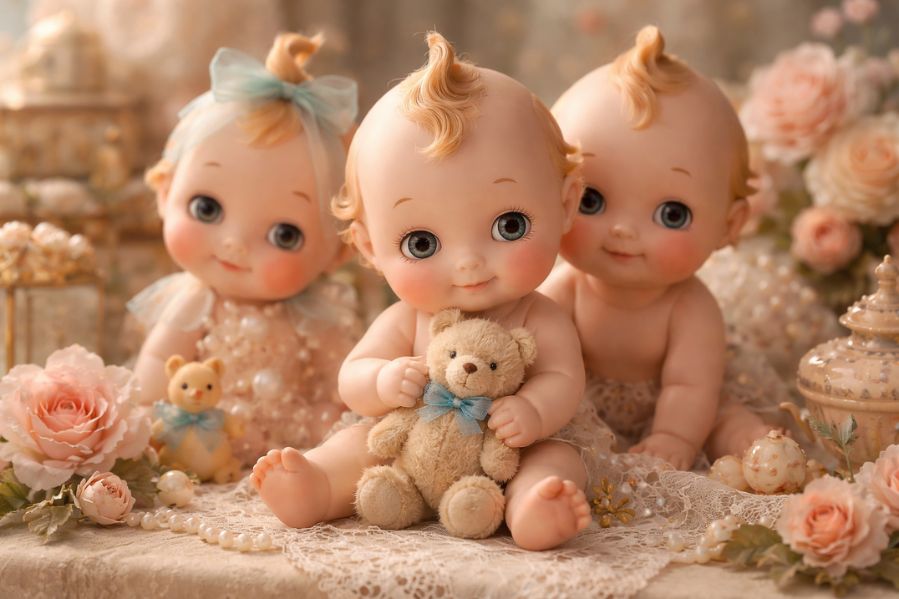

The Kewpie doll is one of the most recognizable character toys ever created, yet its appeal reaches far beyond the nursery or collector’s shelf. With its rounded body, mischievous side-glancing eyes, tiny topknot of hair, and cherub-like expression, the Kewpie became more than a doll soon after it entered public life in the early twentieth century. It represented a mood, a style, and a moral message. At the heart of its story stands Rose O’Neill, the American illustrator who introduced the Kewpies in 1909 and turned them into a rare early example of a character that thrived across print, toys, advertising, and household goods. The Kewpie’s rise was not accidental. It was the product of strong visual storytelling, clever licensing, and a public appetite for innocence and optimism during a rapidly changing era.
What Is a Kewpie Doll?
A Kewpie doll is a baby-like figurine based on the Kewpie characters created by Rose O’Neill. The name itself comes from Cupid, which helps explain the doll’s sentimental charm. O’Neill described her Kewpies as little beings meant to teach people to be “merry and kind,” which gave them a warm emotional identity from the beginning. They were not designed as ordinary baby dolls. Instead, they were imagined as playful, otherworldly little figures with a distinct personality. That difference helped the Kewpie stand out in a crowded market and gave it a strong cultural identity that survived well beyond its first wave of popularity.
The Origins of the Kewpie Doll
Rose O’Neill and the Birth of the Kewpies
The Kewpie story begins with Rose O’Neill, a pioneering American illustrator and cartoonist whose career broke barriers for women in publishing and visual culture. By the time Kewpies appeared, O’Neill had already earned a reputation as a talented artist. The Kewpie characters transformed her into a major commercial force. Historical accounts from the Library of Congress and other institutions indicate that the Kewpies first appeared in Ladies’ Home Journal in 1909. Readers were introduced to their whimsical adventures and moral sweetness. Their popularity expanded quickly as they also appeared in other publications, helping the characters reach a broad national audience.
From Page to Doll
The leap from printed illustration to physical doll was crucial. Once readers connected with the Kewpies on the page, manufacturers recognized their commercial potential. Early Kewpie dolls were produced in bisque, and the character soon moved into other materials as manufacturing evolved. This transformation from cartoon character to object of everyday ownership made Kewpie one of the earliest and clearest examples of successful mass character merchandising. The doll’s fame spread internationally, and O’Neill herself became closely associated with the brand’s expansion. By the 1910s, Kewpie was no longer simply a comic creation. It was a full commercial phenomenon.
Why the Kewpie Doll Became So Popular
A Memorable Design
Part of the Kewpie doll’s success lies in its unforgettable appearance. The figure combines innocence with mischief. Its body is soft and rounded, but the expression is never blank. The sideward gaze gives it wit. In some illustrations, the topknot and small wings connect it to a fairy-like or Cupid-inspired identity. These details made the doll instantly recognizable, even in small sizes or simplified versions. In branding terms, Rose O’Neill created a visual icon long before modern entertainment companies perfected the same strategy.
A Moral Message with Commercial Power
The Kewpie did not succeed on looks alone. It carried a clear emotional message. O’Neill’s own description of the characters emphasized kindness, cheerfulness, and playful goodness. That made the Kewpie attractive not only to children but also to adults. Many saw it as wholesome, comforting, and giftable. In an age when magazines shaped household taste and consumer culture, that combination of sentiment and visual appeal proved powerful. The result was a character that worked equally well in storytelling, toys, cards, decorative objects, and advertising.
Kewpie Dolls and Early Merchandising Culture
One reason the Kewpie doll still matters historically is that it helped define what character merchandising could become. The Kewpie brand expanded into books, postcards, household items, and product promotions. It showed that a successful illustrated character could live across multiple formats. Several historical sources describe O’Neill as one of the first creators to build a major merchandising empire from her own work. That achievement was especially notable because she was a woman working in a period when the commercial and artistic worlds were heavily male-dominated. Kewpie was not just a toy craze. It was a business model that anticipated much of twentieth-century brand culture.
The Materials and Evolution of the Dolls
Early Bisque Kewpies
The earliest and most prized Kewpie dolls were often made of bisque, a ceramic material that gave them a smooth, delicate finish. These early versions are especially valued by collectors today because they connect directly to the first era of Kewpie production. Antique examples, especially those signed or closely associated with the earliest licensed manufacturers, are widely sought after. Their survival also reminds collectors that Kewpies were not disposable novelties. Many were made with real craftsmanship and were treasured enough to be preserved for generations.
Later Versions and Wider Distribution
As materials and toy manufacturing changed, Kewpie dolls appeared in a variety of compositions, including hard plastic, rubber, vinyl, and other materials. This evolution helped the character stay in circulation long after the original bisque era. The design remained familiar even as production methods became cheaper and more scalable. That continuity is one reason Kewpie never disappeared entirely. It adapted to new markets while retaining its essential face and form.
Kewpie Dolls as Collectibles
Today, the Kewpie doll occupies an important place in the world of antiques and collectibles. Collectors often distinguish between original early dolls, later licensed products, reproductions, and modern interpretations. Age, condition, size, markings, and provenance can all influence value. The strongest interest usually surrounds the earliest bisque examples and dolls linked most closely to Rose O’Neill’s original period of success. Yet collecting Kewpies is not only about rarity or price. For many enthusiasts, the attraction lies in the doll’s expressive charm. The sense that it captures a lost style of sweetness in American popular culture also draws collectors.
The Lasting Cultural Appeal of the Kewpie Doll
Even after more than a century, the Kewpie remains culturally legible. Its face still feels familiar, whether encountered in antique shops, vintage advertising, doll museums, or pop-inspired design. Part of that endurance comes from nostalgia, but nostalgia alone cannot explain such a long lifespan. The Kewpie survives because it was built on a clear visual identity and emotional simplicity. It is cute without being generic. It is old-fashioned without being unreadable. It also carries the aura of early modern illustration, when print culture, design, and commerce were finding new ways to overlap. In that sense, the Kewpie doll belongs not only to toy history but also to the history of branding, illustration, and consumer imagination.
Why the Kewpie Doll Still Matters
The continued fascination with the Kewpie doll speaks to the enduring nature of character creation. Rose O’Neill did not produce a passing novelty. She created a figure with a moral tone, a distinctive silhouette, and a flexibility that allowed it to move across media. That combination made Kewpie one of the earliest modern icons of character culture. It also secured O’Neill’s own place in history as an artist, entrepreneur, and cultural innovator. For readers interested in dolls, vintage design, women’s history, illustration, or collecting, the Kewpie remains a remarkable subject because it sits at the intersection of all those worlds.
Conclusion
The Kewpie doll began as a charming illustrated figure in 1909, but its story quickly grew into something much larger. Through Rose O’Neill’s imagination, the Kewpie became a symbol of kindness, joy, and visual originality. Through manufacturing and merchandising, it became a landmark in the history of popular culture. Through collectors and admirers, it has remained alive for more than a century. What makes the Kewpie endure is not only its appearance, though its design is unforgettable. It is the feeling the doll carries: innocence touched by humor, sweetness shaped by character, and nostalgia anchored in genuine artistic history. In that sense, the Kewpie doll is not simply an antique toy. It is one of the early modern world’s most successful and enduring little icons.
(FAQs)
Who created the Kewpie doll?
The Kewpie doll was created by American illustrator Rose O’Neill, who first introduced the Kewpie characters in 1909.
Why is it called a Kewpie doll?
The name is derived from Cupid, which reflects the doll’s cherubic, affectionate image.
Where did Kewpies first appear?
Kewpies first appeared in Ladies’ Home Journal before becoming dolls and other merchandise.
What makes a Kewpie doll recognizable?
A Kewpie doll is known for its round face, chubby body, side-glancing eyes, and signature topknot, features that set it apart from other dolls.
Are Kewpie dolls valuable today?
Some are. Early bisque Kewpie dolls, especially well-preserved or rare examples, are widely sought after by collectors.