
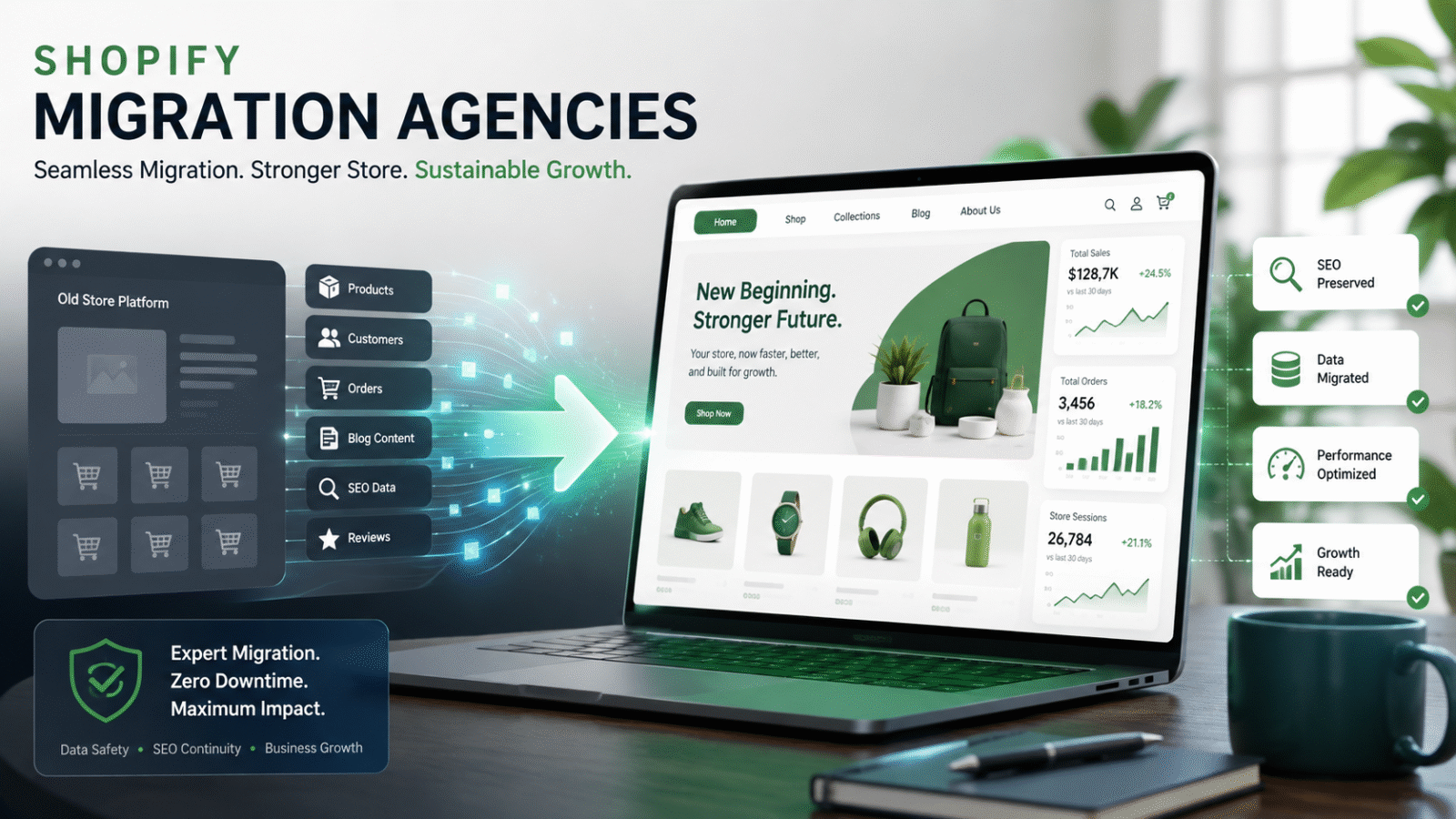

TL;DR
- A Shopify replatform is a revenue project, not a development task. Most of the damage brands suffer comes from lost search rankings and incomplete data transfers, not from the platform itself.
- The ten agencies below all run a documented migration practice rather than listing migration as one service among fifty.
- Budgets run from roughly $5,000 for a small clean catalog to $50,000 and beyond for a complex multi-market build.
- The four things worth checking before signing: how redirects are mapped, what data is validated, who owns the store after launch, and whether the team has handled your specific source platform before.
Moving an online store to a new platform used to be a technical decision. In 2026 it is a commercial one. A replatform touches product data, customer accounts, order history, tax logic, search rankings, and every system connected to the back office, which means the choice of partner shapes revenue long after the launch date passes.
Most brands underestimate this. They compare quotes, pick the cheapest credible option, and discover months later that organic traffic never fully recovered or that half their order history did not survive the transfer. The cost of that mistake usually dwarfs the difference between the quotes.
The agencies below approach migration as a revenue project rather than a data export.
Ecommerce platforms age quietly. Maintenance windows stretch. Every new integration turns into a custom engineering request. Checkout stays rigid while customer expectations keep moving.
At some point, the arithmetic changes and another year of patches costs more than a clean move. Shopify and Shopify Plus absorb most of that demand because the infrastructure is hosted, the checkout is extensible, and the app ecosystem covers the majority of operational needs without bespoke development.
The move itself is where the risk sits. Handled properly, nothing about it reaches the storefront. Handled badly, it surfaces as broken redirects, orphaned customer records, missing variants, and a conversion dip that takes weeks to trace back to its source.
That is why the agency matters more than the platform.
Quick Comparison
| # | Agency | Base | Strongest on | Best fit |
|---|---|---|---|---|
| 1 | Northbound Commerce | Europe | Complex data, custom logic, migration plus CRO in one team | Mid-market and enterprise brands |
| 2 | magic42 | UK | B2B Magento and ERP-connected replatforms | B2B and industrial merchants leaving customized Magento |
| 3 | Bedford Lane | Australia | Design-led replatforming | Fashion, beauty and lifestyle brands wanting a visual reset |
| 4 | Noughts & Ones | UK | Low-impact, sustainability-focused builds | Independent purpose-led brands |
| 5 | Velt2 | Europe | High-volume migration delivery without a redesign | Merchants who want the platform move handled on its own |
| 6 | Fhoke | UK | Data architecture analysis before design | Stores with messy or non-standard data models |
| 7 | Optiexperts | UK | SEO-audit-first migration planning | Brands where organic search is the main channel |
| 8 | Shero Commerce | US | Complex Magento and BigCommerce with B2B logic | North American merchants on long-established builds |
| 9 | Novatize | Canada | Structured delivery for bilingual markets | Mid-sized brands in Canada and French-speaking markets |
| 10 | WeblineIndia | US and India | Cost-controlled delivery with integration work | Budget-conscious migrations with internal oversight |
The 10 Best Shopify Migration Agencies
This list was last reviewed in July 2026. Agencies are ordered by fit for a midsized or enterprise brand moving a live store with real order history, connected systems, and custom functionality, not by size or spend. The criteria were reviewed independently and no agency paid to be included or to influence its ranking.
1. Northbound Commerce
Northbound Commerce is a Shopify Premier agency operating out of Europe, working exclusively inside the Shopify ecosystem for over a decade.
Migration and conversion work sit inside the same team, so brands do not just arrive on Shopify with their data intact; they arrive measurably better than they left.
Published case work spans flooring, FMCG and consumer electronics brands rebuilt on Shopify Plus, with load time and conversion movement reported per project rather than claimed in the abstract.
The technically demanding work sits in the same portfolio: moves off Shopware and other legacy stacks with product data, order history and customer accounts intact, a multi-currency international setup layered on top, and enterprise gateways such as Adyen integrated for global payments.
Larger Plus rebuilds have covered multi-region internationalization, ADA accessibility compliance and custom private app development.
Where legacy functionality does not map onto Shopify, the team rebuilds it as a Shopify app rather than abandoning it.
Best for: brands replatforming with complex data, custom business logic and international requirements, where conversion performance matters as much as a clean transfer.
2. Magic42
magic42 is a UK agency that holds Shopify Plus credentials alongside deep Adobe Commerce and Magento experience. That combination is unusual and genuinely useful, because the team understands the platform being left as well as the one being joined.
Recent work includes a multi-site B2C migration from Magento to Shopify Plus with ERP integration, and a six-site B2B and D2C move off OpenCart onto Shopify Plus. Integration work spans Klaviyo, ShipperHQ, Doofinder and retail management systems.
The fit is clearest on B2B builds, where procurement workflows, tiered pricing and multi-store architecture rarely translate cleanly and need to be redesigned rather than copied.
Best for: B2B and industrial merchants leaving heavily customized Magento.
3. Bedford Lane

Bedford Lane is a Melbourne studio and Shopify Plus Partner that treats a migration as an opportunity to reposition the brand rather than simply relocate it. Migrations are handled from Magento, BigCommerce, Salesforce Commerce Cloud, Neto, WordPress and WooCommerce.
The portfolio is concentrated in fashion, beauty, jewelry and lifestyle, including a replatform for footwear brand Tony Bianco and Shopify Plus builds for Kit: and Calibre Menswear. The team supports projects across Australia, New Zealand, the UK and the US.
The fit is clearest for brands whose storefront is part of the brand rather than a container for it.
Best for: lifestyle and fashion brands wanting migration and a full visual refresh in one project.
4. Noughts & Ones
Noughts & Ones is a Bristol-based B Corp and certified Shopify Expert working with purpose-led and independent brands. The team built its own delivery framework, Conscious Development, around efficient code, optimized media and a lower digital footprint, which has the useful side effect of producing faster stores.
Recent work includes a Squarespace to Shopify move for Edmunds Cocktails with subscriptions in scope, plus builds for Wiper and True and Grace & Green.
The team is small enough that clients deal directly with the people doing the work, which suits brands that find larger agencies slow to respond.
Best for: independent and sustainability-minded brands moving off Squarespace, Wix or WooCommerce.
5. Velt2
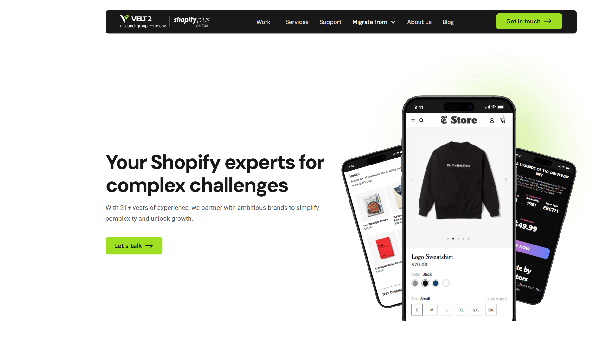
Velt2 is the Shopify arm of the scandi group, bringing more than two decades of enterprise ecommerce heritage. Projects include moving Swedish fashion brand Hope from Commercetools to Shopify Plus with a Microsoft Dynamics NAV integration.
The delivery model is built around predictability. Migration runs in a sandbox so the existing store stays live throughout, followed by regression testing, an SEO review and 24-hour monitoring after go-live.
The scope is deliberately narrow. Merchants happy with their current storefront can have the platform move handled as its own piece of work, without a redesign folded into the same project.
Best for: merchants who want a stable, well-rehearsed migration without a simultaneous rebuild.
6. Fhoke

Fhoke is a London agency that opens migrations with data architecture analysis rather than design. The team maps how content, customers and orders are structured on the source platform before deciding how any of it should land on Shopify.
Source platforms covered include Magento, WooCommerce and BigCommerce, with the stated goal of keeping store content unchanged from a customer’s point of view across the transfer.
Best for: merchants whose current data model is messy or non-standard.
7. Optiexperts
Optiexperts runs a detailed SEO audit before any migration work begins, using it to establish what rankings and traffic exist and what has to be protected. Redirect planning follows from that audit rather than being assembled at the end.
The agency covers Magento, WooCommerce, and BigCommerce sources into both Shopify and Shopify Plus.
Best for: brands where organic search is the primary acquisition channel.
8. Shero Commerce

Shero Commerce is a US agency handling complex Magento and BigCommerce replatforms, typically for merchants whose current build carries years of accumulated customization and intricate B2B logic.
One representative project consolidated a client’s fragmented WordPress and Shopify properties onto a single Shopify platform and rebuilt the technical SEO foundation.
Projects of that shape tend to fail on assumptions about what transfers cleanly, and Shero’s work is oriented around surfacing those gaps early rather than discovering them mid-build.
Best for: North American merchants leaving long-established Magento or BigCommerce stores.
9. Novatize
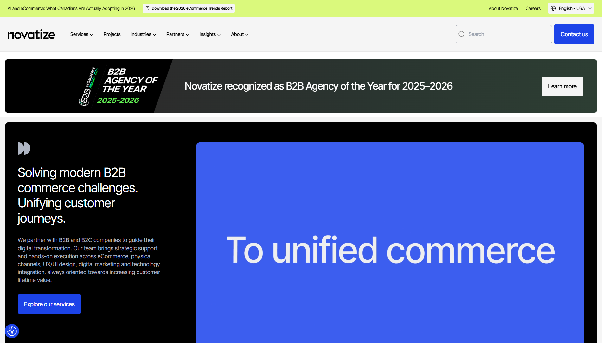
Novatize is a Canadian ecommerce agency handling Shopify and Shopify Plus migrations from Magento, WooCommerce and custom systems. Project management is the visible strength: defined milestones, consistent communication and few surprises.
The team supports French-language commerce, which makes it a practical option for brands selling into Quebec and other bilingual markets where most agencies cannot help.
Best for: mid-sized brands wanting a dependable technical partner without enterprise-scale complexity.
10. WeblineIndia

WeblineIndia operates across the US and India, covering Shopify and Shopify Plus development, migrations, app work, and CRM or ERP integration.
Delivery is offshore, and pricing reflects that, making the team a practical option for merchants with real complexity but a limited budget and the internal capacity to keep scope tight.
Best for: cost-sensitive migrations with internal project oversight.
What a Shopify Migration Typically Costs
Migration cost tracks four variables: catalog size, integration complexity, whether a redesign is in scope, and how much custom business logic has to be rebuilt rather than carried over.
| Store profile | Typical scope | Directional range |
|---|---|---|
| Small | Under 5,000 SKUs, minimal integrations, no custom logic | $5,000 to $15,000 |
| Mid-market | 5,000 to 50,000 SKUs, ERP or CRM connections, some custom logic | $15,000 to $50,000 |
| Enterprise | Custom architecture, multi-market setup, high-volume catalog, redesign included | $50,000 and up |
These are reference points rather than quotes. Serious agencies scope against the real state of a store, which is why most ask for a discovery call and access to the current build before naming a number. A fixed price offered before that review usually signals a shallow one.
What Separates a Strong Migration Partner From an Average One
Every agency claims to protect SEO. Fewer can describe how before being asked. A credible partner will explain redirect mapping, URL continuity, and metadata migration unprompted, because those are the first things they plan.
Data scope is the second signal. Products, variants, customers, order history and reviews should all be named explicitly in the proposal, along with a validation pass after import. Anything left vague at proposal stage tends to be left out at delivery stage.
The third is ownership after launch. An agency that hands over at go-live leaves the merchant to diagnose problems alone during the precise window when problems appear. The strongest partners run the move and stay.
The fourth is fit. A team that has migrated stores at a comparable size, in a compatible timezone, with experience of the specific source platform, hits fewer surprises than a larger agency taking on an unfamiliar shape of project.
Key Takeaways
- Pick for fit, not size. An enterprise agency will overprice a small store and a boutique studio will stall on a complex multi-market build. Match the team to the shape of the project.
- Search continuity is the highest-risk item. Redirect mapping, URL structure, and metadata should be in the proposal as standard scope. If it is quoted as an add-on, expect a traffic drop.
- Validation matters more than import. Most post-launch problems are records that moved incorrectly and went unnoticed, not dramatic failures. Ask how many records get checked before go-live.
- The team that migrates should be the team that stays. The first weeks of live traffic are when the edge cases surface, and that is the worst possible moment to be handed off to strangers.
Frequently Asked Questions
How long does a Shopify migration take?
Most migrations run between 6 and 16 weeks, depending on catalog size, the number of integrations, and whether a redesign is included.
Stores with heavy custom logic or long order histories sit at the higher end. Any timeline quoted before a technical audit of the current store is guesswork.
Will migrating to Shopify hurt my search rankings?
It can, and this is where most brands lose money. Rankings hold when the agency produces a complete redirect map from old URLs to new ones, preserves URL structure where possible, migrates metadata and runs a post-launch pass for broken links. Ask to see the redirect process described before signing.
What data actually moves during a migration?
At minimum: products, variants, collections, customers, order history, pages, blog content and SEO fields. Reviews, gift cards, store credit and subscriptions often need separate handling. Customer passwords are hashed and cannot be transferred, so shoppers will need to reset them.
Should I use a migration app instead of hiring an agency?
For a small, clean catalog with no custom functionality, a migration app is the faster and cheaper path. Apps move data, but they do not plan redirects, protect search equity, rebuild integrations, or recreate custom features. Once real traffic and revenue are involved, an agency that owns the full scope is the safer call.
Do I need Shopify Plus, or is standard Shopify enough?
Many brands migrate to standard Shopify first and upgrade later. Plus becomes the right destination when checkout extensibility, B2B functionality, multi-store management, or higher API limits are already requirements, because going there directly avoids a second move. A good agency will say which applies rather than defaulting to the larger plan.
Conclusion
Replatforming is one of the few projects that can reset an ecommerce trajectory in a single move. Done well, it clears years of technical debt, protects the search equity already earned, and hands customers a faster store. Done badly, it costs months of recovery.
The right partner depends on the shape of the business. Brands with complex data, custom logic, and international requirements need a team with engineering depth and conversion capability under one roof.
Independent brands moving off a simpler platform are better served by a smaller studio that will actually pick up the phone.
What every option on this list shares is a documented migration practice rather than migration offered as an afterthought. That distinction is the one worth applying to any agency, including those not listed here.