

Real battlefields don’t lie. Walk across Omaha Beach or stand at the edge of the Auschwitz-Birkenau perimeter, and you feel something no studio backlot can manufacture. That feeling — heavy, specific, irreversible — has quietly reshaped war cinema for decades. These 5 historical sites didn’t just inspire filmmakers. They fundamentally changed how directors shoot, frame, and morally approach stories about armed conflict. Whether you’re a film enthusiast, a history student, or someone planning to visit these places, understanding their influence gives you a richer lens for both watching movies and reading the past.
The Power of Place: When Location Becomes the Director
Some locations resist dramatisation. When filmmakers stand on real historical ground, the terrain itself starts to make creative decisions for them. Three sites proved this point with particular force.
Omaha Beach, Normandy — The Birth of Immersive Realism
Steven Spielberg’s Saving Private Ryan (1998) redefined what a war film is allowed to look like. The film’s opening 27 minutes remain among the most studied sequences in cinema history — not because of their scale, but because of their texture.
Spielberg and cinematographer Janusz Kamiński visited Omaha Beach extensively before production. The site’s exposed gradient, the lack of natural cover, and the relationship between sea and sand directly shaped their decision to use handheld cameras, desaturated colour correction, and shutter speeds that mimic WWII-era combat photography.
What changed after 1998? Nearly everything. The immersive realism standard that Saving Private Ryan set made earlier choreographed battle sequences look immediately dated. Productions from Black Hawk Down (2001) to Dunkirk (2017) adopted variations of the same visual philosophy — one that originated on a stretch of French coastline, not in a screenwriter’s room.
Gallipoli Peninsula, Turkey — Restraint as a Cinematic Choice
Peter Weir’s Gallipoli (1981) took a different approach. Filming on and around the actual 1915 battleground in Turkey, Weir encountered something that resisted Hollywood dramatisation: the preserved trenches are quiet, intimate, and almost unbearably close together.
That proximity forced narrative restraint onto the production. Weir couldn’t stage wide heroic advances — the geography wouldn’t allow it. Instead, the film turned inward, focusing on the psychological lives of 2 young Australians in the months before the slaughter.
This shift had lasting consequences for how Commonwealth nations tell war stories on screen. The Gallipoli template prioritises grief over glory, the individual over the nation, and silence over spectacle — a template still visible in productions like Beneath Hill 60 (2010).
The Somme and the Single-Take Philosophy
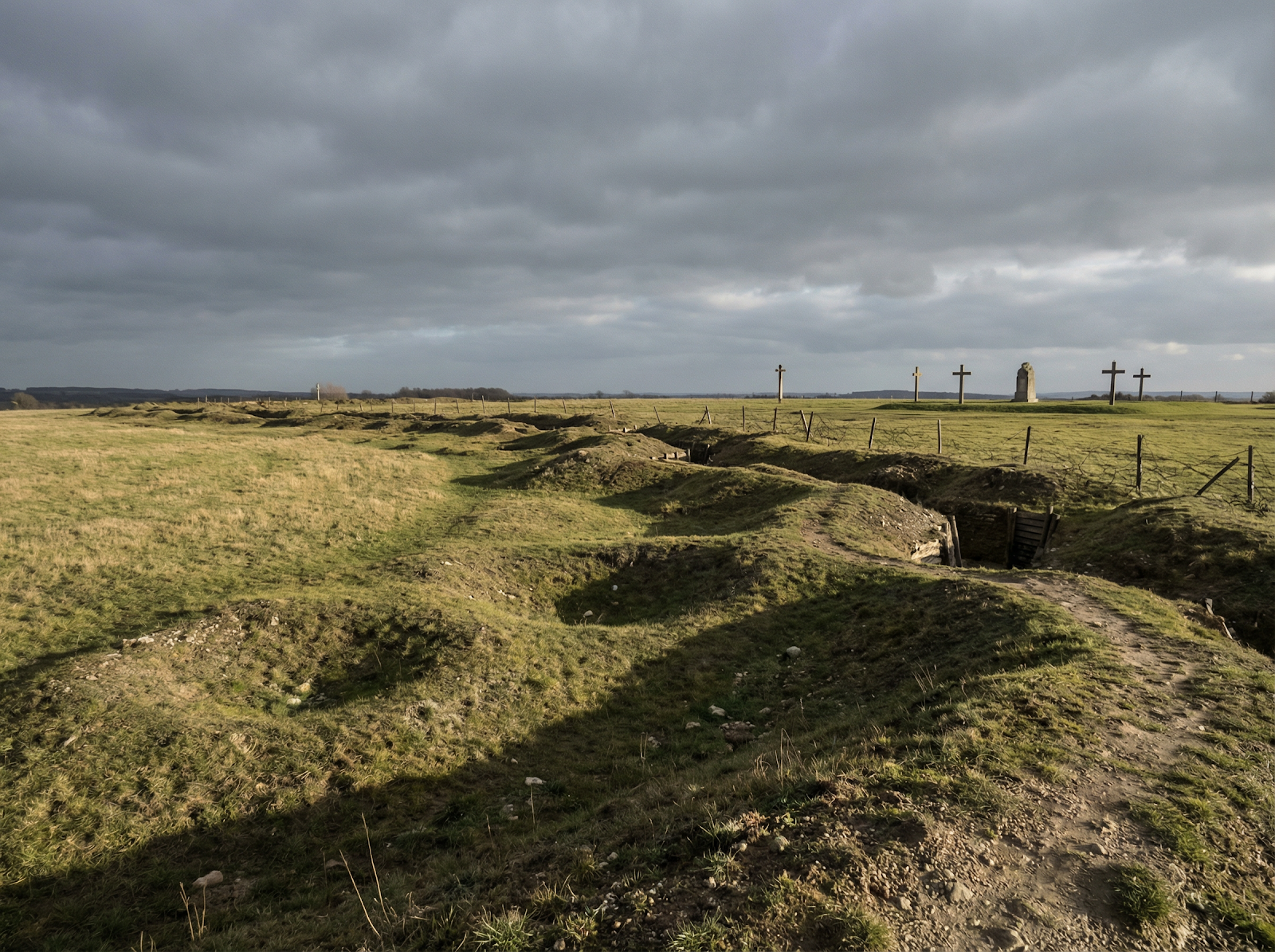
The Somme battlefield in northern France presents a landscape unlike any other war site in Europe. Its crater fields, preserved trenches, and vast open terrain challenged every conventional instinct about battle choreography.
Sam Mendes cited the Somme’s geography among the influences that shaped 1917 (2019), a film structured as a single continuous take following 2 British soldiers across the Western Front. The site’s scale cannot be faked or summarised — you must traverse it. Mendes and cinematographer Roger Deakins responded by creating a film that moves through space rather than cutting between spaces, a direct formal response to what that terrain communicates.
Sacred Ground: Sites That Changed Filmmaking Ethics
Some locations raise questions that go beyond visual style. They force filmmakers to ask what they are morally permitted to show — and where representation ends and exploitation begins.
Auschwitz-Birkenau — The Question of Representation
No site has generated more sustained debate about the ethics of cinematic representation than Auschwitz-Birkenau. When Spielberg filmed Schindler’s List (1993), he made a deliberate choice: the production would film adjacent to the camp, not inside it. That boundary shaped the film’s entire visual language.
Filming near Auschwitz forced the crew to confront what could and could not be shown. The decision to shoot almost entirely in black-and-white acknowledged the impossibility of full representation. The famous red coat only works because everything else refuses to aestheticise the horror.
Jonathan Glazer’s The Zone of Interest (2023) took the opposite formal approach. By filming directly on the perimeter of the Auschwitz-Birkenau complex — with the camp visible beyond the garden wall — Glazer enforced a deliberate absence. The audience never enters the camp. The violence exists offscreen, inferred rather than depicted.
These 2 productions sparked a debate that continues today: does proximity to authentic locations humanise historical trauma, or does it risk aestheticising it? There is no clean answer, but the question has raised the ethical bar for every subsequent production dealing with sites of atrocity.
If you want to engage with this history directly, visit the Auschwitz-Birkenau Memorial as part of a structured tour from Kraków. Guided access with proper historical context makes all the difference — check your options at https://benimarco.es/. KrakowDirect is among the transport providers connecting Kraków with the memorial site for visitors making this journey.
Hiroshima Peace Memorial — A Non-Western Visual Language
The preserved ruins of the Genbaku Dome in Hiroshima — the only structure left standing near the bomb’s hypocenter — created a visual vocabulary for nuclear devastation that Western cinema has repeatedly borrowed.
Japanese filmmakers working in the decades after 1945 prioritised the civilian body, slow time, and the absence of resolution. Films like Barefoot Gen (1983) and Black Rain (1989) drew directly from the physical reality of what Hiroshima looked like decades after the bombing. The Genbaku Dome communicates something that CGI reconstruction cannot: destruction is permanent, not dramatic.
Western productions grappling with civilian casualties — from Apocalypse Now (1979) to recent streaming productions — have increasingly borrowed the visual grammar that originated in Japanese filmmakers’ direct engagement with Hiroshima. The shift toward depicting war’s consequences rather than its action owes more to that single preserved dome than most Western critics acknowledge.
From Battlefield to Backlot: The Industry’s Lasting Shift
Location-authentic filmmaking didn’t just change individual productions. It changed how the industry structures production roles and how audiences judge historical credibility on screen.
Historical Consultants and the Authenticity Standard
One measurable consequence of filming on real historical ground is the rise of the dedicated historical consultant as a standard production role. Before Saving Private Ryan, historical advisors were common but rarely held structural authority over visual decisions. After 1998, their role expanded significantly.
This shift originated directly from the practical demands of filming on real ground, where inaccuracies become visible in ways a studio set would never expose. Streaming platforms funding serious war narratives have continued this trend. Authenticity has become a competitive advantage, not a courtesy.
Tighter Access, More Creative Thinking
Access to historical sites is becoming more regulated. The Gallipoli Peninsula is now strictly managed by Turkish and Australian authorities. Auschwitz-Birkenau’s Memorial and Museum maintains explicit guidelines about what filmmakers can shoot and how.
These restrictions are not obstacles to creativity — they are prompts for it. Every constraint that a sensitive site imposes has historically produced more thoughtful formal choices, not fewer. The question facing the next generation of war filmmakers is not whether to engage with historical sites, but how to do so responsibly when direct access is limited.
The Ground Beneath the Story
Returning to these 5 sites — Omaha Beach, the Gallipoli Peninsula, the Somme, Auschwitz-Birkenau, and Hiroshima — what becomes clear is that their influence on cinema is structural, not decorative. Each site imposed specific demands on the filmmakers who encountered it, and those demands produced innovations that changed the industry’s baseline assumptions about how war should look and feel on screen.
No set design replicates what genuine historical ground communicates to a director’s instincts. The specific quality of light at Omaha Beach, the claustrophobic proximity of Gallipoli’s trenches, the absolute silence inside the Auschwitz-Birkenau perimeter — no software can generate these.
Visit these places before you try to represent them. Let the ground tell you what it knows.