
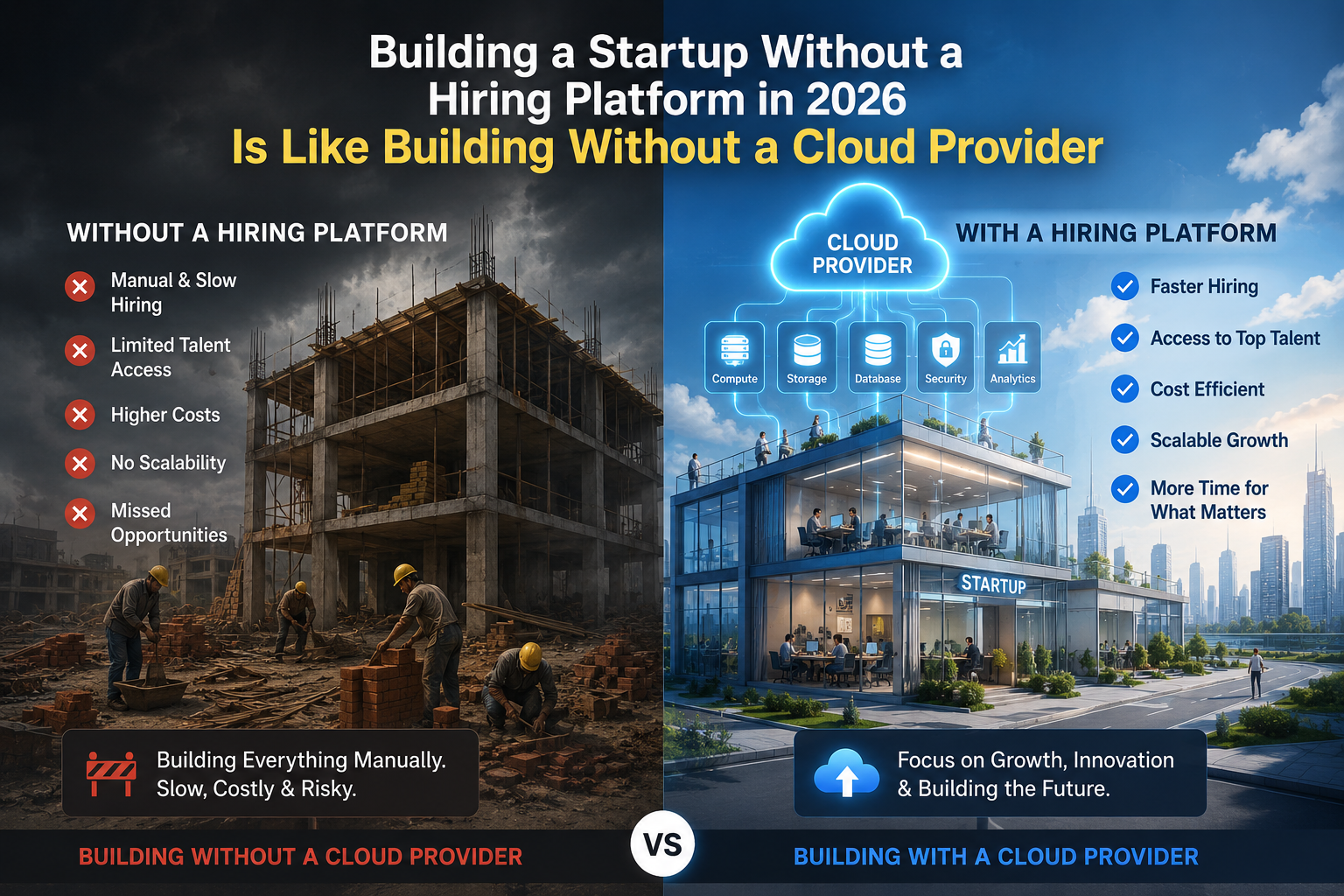

Cast your mind back to the early 2000s. If you wanted to launch a tech startup, you needed servers. Physical servers. You bought them, housed them, configured them, maintained them, and prayed they did not go down on a Friday night before a product launch. The cost was enormous. The complexity was punishing. And the time spent on infrastructure was time stolen from building the actual product.
Then cloud computing arrived and changed everything. AWS, Google Cloud, Microsoft Azure these platforms transformed infrastructure from a capital-intensive, expertise-heavy burden into a utility. You provision what you need, when you need it, at a fraction of the cost, with enterprise-grade reliability from day one. No serious startup founder in 2026 builds their own data center. That battle was settled a decade ago.
The same transformation is now happening in hiring. And the founders who recognize it earliest are gaining an advantage that compounds every quarter.
The Infrastructure Analogy Is Not a Metaphor – It Is a Blueprint
Think about what cloud computing actually did for startups. It did not just reduce cost although it reduced cost dramatically. It eliminated an entire category of non-core work from the founder’s plate. Nobody at a Series A startup is debating which hard drives to buy or how to configure their network topology. Those decisions are abstracted away by a platform that has already solved them at scale, with far more expertise than any individual startup could bring to bear.
The AI hiring platform does exactly the same thing for talent acquisition. It abstracts away the non-core work of finding, screening, assessing, and shortlisting candidates work that consumes founder bandwidth, demands specialist expertise, and produces wildly inconsistent results when done ad hoc and replaces it with a reliable, scalable, expert-operated system that delivers outcomes on demand.
Just as a startup using AWS does not need a team of infrastructure engineers to run its backend, a startup using the right AI hiring platform does not need a head of talent acquisition, a team of recruiters, or months of open pipeline management to find a world-class developer. The platform handles that. The founder gets the outcome.
That is not a metaphor. That is exactly how modern startup hiring infrastructure works.
What DIY Hiring Really Costs a Founder in 2026
The founders who still approach hiring the old way writing job descriptions, posting to boards, manually screening inbound applications, conducting multiple rounds of interviews across an undifferentiated candidate network are not saving money. They are spending it in a currency more valuable than cash: time.
- Consider the actual time investment of a self-managed engineering hire.
- Writing and refining the job description: 3–5 hours.
- Managing the job board listings and inbound applications: 4–6 hours per week over a 6–10 week search.
- Initial screening calls with 20–30 candidates: 15–25 hours.
- Technical assessments and debrief sessions: 8–12 hours.
- Final round interviews and reference checks: 5–8 hours. Offer negotiation and paperwork: 3–5 hours.
Total: upwards of 60–80 hours of founder time per hire. At a conservative opportunity cost of $300 per hour for a founder’s time, that is $18,000 to $24,000 in lost productivity for a single engineering role, before accounting for the cost of a wrong hire or an extended search.
No founder would build their own servers to save on AWS costs. The math does not work. The same math applies to DIY hiring in 2026.
The Five Parallels Between Cloud and Hiring Infrastructure
The parallels between what cloud providers did for technical infrastructure and what AI hiring platforms are doing for talent infrastructure are striking and instructive:
- On-demand provisioning. Cloud: spin up a server in minutes. AI hiring platform: receive pre-vetted candidate profiles within 48 hours. Both eliminate the long lead times that used to make scaling slow and painful.
- Built-in quality assurance. Cloud: enterprise-grade reliability and security baked in. AI hiring platform: rigorous multi-stage vetting baked in. Neither requires the startup to build quality control from scratch.
- Elastic scalability. Cloud: scale up or down as demand changes. AI hiring platform: hire one developer or ten, ramp up or pause as the business requires, without fixed infrastructure costs.
- Pay for outcomes, not overhead. Cloud: pay for compute used, not hardware owned. AI hiring platform: pay when a hire is made, not for the search itself. Both eliminate the sunk-cost model of the previous era.
- Expert operations you never have to think about. Cloud: AWS manages the physical infrastructure so you never think about it. AI hiring platform: Uplers manages sourcing, vetting, contracts, payroll, and compliance so you never think about it. Both let founders focus entirely on their core product.
The Inflection Point Has Already Happened
There was a moment in the early 2010s when the question shifted from “should we consider using cloud infrastructure?” to “why would we not?” That inflection point happened gradually, then suddenly. The cost advantages became undeniable. The reliability track record became established. The expertise gap between what a startup could build internally and what a cloud provider delivered became too wide to justify the DIY approach.
That same inflection point in hiring is happening right now. The AI hiring platform category has matured to the point where the advantages speed, quality, cost efficiency, risk reduction, compliance management are not marginal improvements over DIY hiring. They are category-defining differences that compound over the course of a startup’s growth.
The founders who are still managing hiring the old way in 2026 are in the same position as the founders who insisted on managing their own servers in 2014. Not wrong in principle just spending enormous energy and capital on a problem that has already been solved, at greater scale and lower cost, by a dedicated platform.
Infrastructure Thinking Changes How Founders Hire
When founders start thinking about hiring as infrastructure rather than as a one-off operational task, everything changes. They stop treating each search as an isolated event and start building a repeatable system. They stop measuring success by whether they filled the seat and start measuring it by time-to-productivity, retention, and team velocity. They stop tolerating the unpredictability of ad hoc hiring and start expecting the reliability that a mature platform delivers.
This shift in thinking from task to infrastructure, from reactive to systematic is what separates the startups that scale their engineering teams with precision from those that lurch from one hiring crisis to the next.
In 2026, the AI hiring platform is not a shortcut. It is not a workaround. It is not a nice-to-have for startups that cannot afford a full HR team. It is foundational infrastructure as essential to building a scalable tech company as the cloud stack that runs its product.
The founders who build on this infrastructure from day one will outpace those who do not. Not because they are luckier or smarter. Because they chose the right tools for the era they are building in.
About Uplers
Uplers is the AI hiring platform that has redefined what startup talent infrastructure looks like. With a curated network of 3.5 million+ pre-vetted professionals from India including graduates of IIT, BITS, and IIM, and alumni of Google, Amazon, and Microsoft, Uplers connects global startups and tech companies with the top 1% of engineering, product, and growth talent, delivering 3–5 interview-ready candidate profiles within 48 hours of receiving a hiring brief.
Like the best cloud providers, Uplers handles the complexity so founders do not have to. Every candidate is screened through a rigorous AI-plus-human vetting process covering technical excellence, communication skills, and remote-work readiness. Contracts, payroll, and compliance are managed end-to-end. And the entire model is built around founder-grade risk management: no-hire, no-fee pricing, a 30-day risk-free cancellation policy, and a lifetime free replacement guarantee.
Uplers is not just a hiring tool. It is the talent infrastructure layer that every modern startup needs and that the smartest founders are already building on.
You would not build without a cloud provider. Do not build without Uplers.
Media contact information: https://www.uplers.com/