
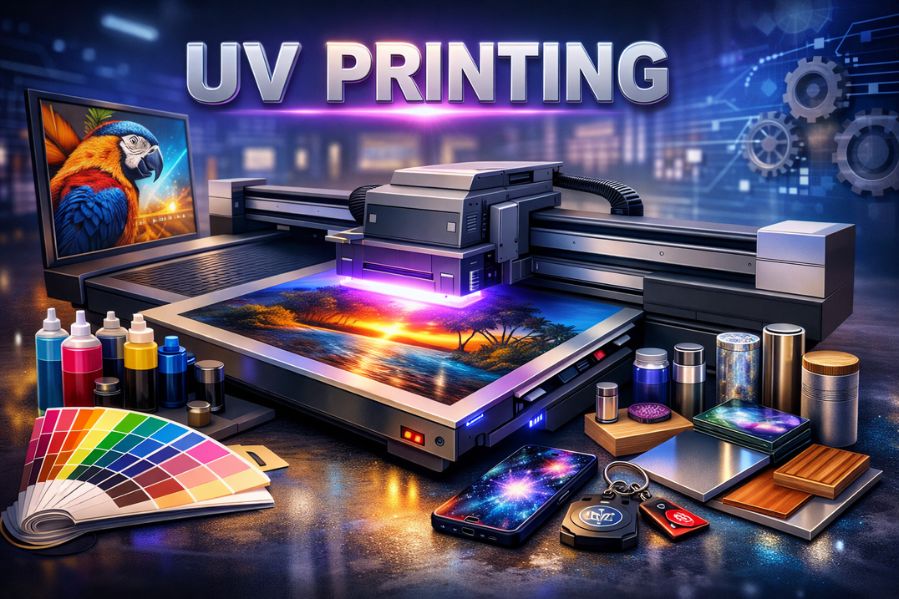

The use of UV printing in modern digital printing has become a significant technology. It is commonly employed in making long-lasting and high-quality prints on various surfaces. UV printing technology uses ultraviolet light to cure the ink immediately, unlike conventional printing processes.
Many manufacturers of printing companies apply UV printing to increase their product offerings. They promote customisation, small production batches, and elaborate designs using this technology. However, companies need to know the working process of this technology before adopting it. Also, where is it used? its application, and the investment needed. The content below will provide a detailed understanding of UV printing.
What Is UV Printing?
UV printing is a computerised printing method. It involves the use of ultraviolet light in order to cure or dry off ink. Then, UV-curable inks are applied to the surface of a material. The ink is then subjected to UV lamps. After that, it undergoes a chemical reaction induced by ultraviolet light. This ink is immediately hardened by this reaction.
The ink does not spread onto the material due to its fast-curing process. This gives clearer and more luminous prints. It is also efficient as it causes less drying time as opposed to solvent or water-based technologies.
How UV Printing Works
The following are the steps involved in the UV printing process.
- The first step is artwork preparation. To develop the design files, graphic design software plays a major role. Using this software gives sharp and high-resolution images.
- The next stage is surface preparation. There is a need for cleaning materials for UV printing technology. It is necessary to prevent ink from being contaminated by dust or oil.
- The third stage is ink deposition. The printer plays its role in placing the ink in the correct location. It sprays the UV- curable ink onto the surface.
- UV curing is the main step of UV printing. It is necessary to cure the ink immediately using UV lamps. This will prevent ink from hardening and will fix the colour.
- The final stage is finishing. Certain prints can be coated or lined with some added protection coatings. This quick-curing property produces a high-quality print.
Advantages of UV Printing
There are several benefits of UV printing. As it presents a number of advantages to manufacturers, suppliers of promotional products, and printing services providers.
- One of the main advantages of using UV printers is their high print quality. UV printing allows elaborate graphics. This comes in handy for branding material and product labelling.
- Instant ink drying is also a major benefit of UV printing technology. Quick curing process protracted drying periods. This feature makes the production faster and more efficient.
- Strong durability of prints also gives benefits to manufacturers for long-term production. UV-cured inks create a hard coating on the surface. This enables the print to be scratch-resistant. It also prevents the prints from fading.
- UV printing can be done on a large range of materials such as glass, wood, metal, plastic, and acrylic. This has enabled companies to design various products without altering the printing technology.
- UV printing is an eco-friendly process. It is less volatile than solvent printing. The inks dry immediately and produce less waste.
Applications of UV Printing
- Signage and advertising are one of the major applications of UV printing. High-quality, high-resolution signs and promotion boards can be made with this technology. UV printers can print Indoor and outdoor signage, retail display panels, and Promotional boards.
- UV printing is one of the printing techniques utilised by manufacturers to print logos and graphics on packaging materials. This enables branding of boxes, containers, and promotional materials.
- Many industries use this technology to print industrial components like electronic panels and control labels.
- This technology has gained popularity for printing promotional products like keychains, phone cases, USB drives, and pens.
- UV printing is also employed in interior design and decorative industries in the creation of customised decor. Companies require high-end equipment and material selections for suppliers to do custom printing. All the digital printing technologies and services based on professional production setups are offered at dtflinko.com
Key Factors to Consider Before Investing
There are some limitations that manufacturers face when using UV printing technology. Businesses must consider these factors before investing in UV printing technology.
- Operating costs mainly include ink costs.
- Workspace requirements.
- Production volume and material types.
- Operator training.
- High Equipment Investment, and surface restrictions using materials.
- Maintenance requirements
Maintenance needs, production capacity, and UV printer cost are important factors when selecting a suitable printing system. So, before investing in UV printing technology, printing companies should consider the limitations outlined above.
Conclusion
Digital printing has incorporated UV printing as a vital technology. UV printing can increase the possibilities of products. It enables high-quality customised printing solutions in a variety of industries when implemented correctly. It can be used to create vibrant and long-lasting print on different materials. This feature makes it useful in manufacturing, advertising, and the customisation of products.