
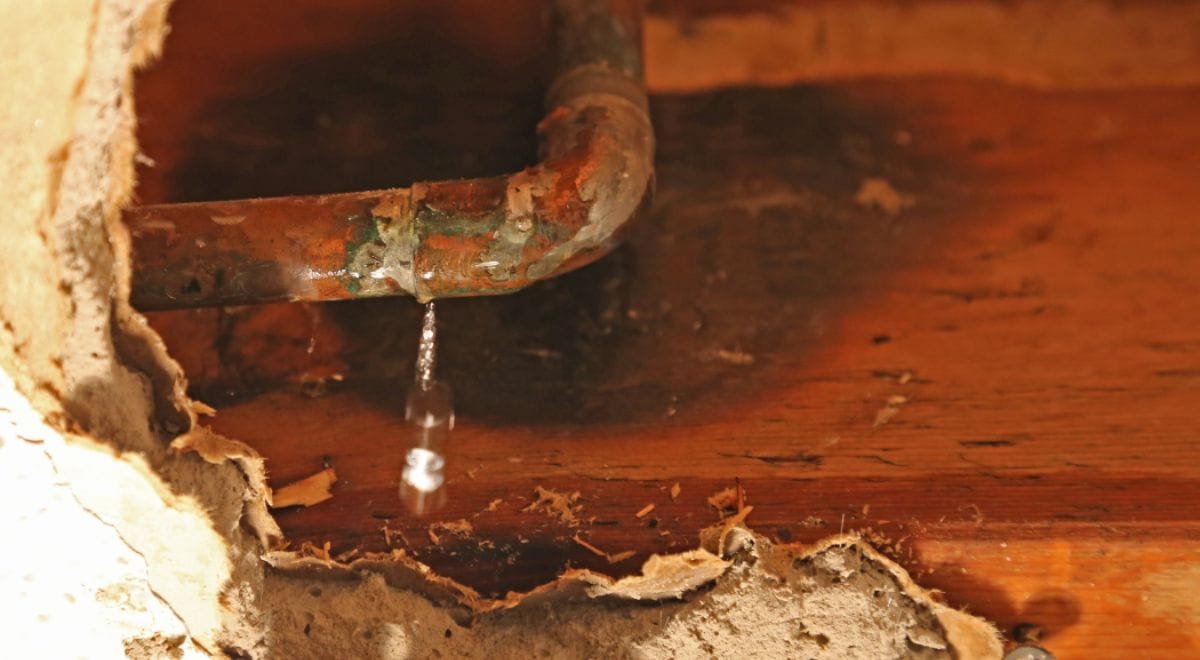

The answer is usually sitting in the low spot. When a forty-mile West Texas gathering system moving about 6,000 barrels a day weeps crude at the same sag twice in eight months, the joint is not the whole story, and neither is the welder who patched it the first time. Water is the story. Free water drops out of the stream where the line dips, settles under the oil, and quietly takes metal off the bottom of the pipe while an inspection upstream reports the wall as fit for service. A search for failure analysis TX turns up plenty of labs, but the deliverable that matters is a named mechanism, not a list of instruments. Cutting out the failed spool and paying a laboratory to identify what ate it costs less than the second repair, and far less than the third.
Low Spots Collect Water And Lose Metal
Crude carries water, and water does not stay mixed. On a gathering line running under its design rate the phases separate, and free water rides the bottom of the pipe until it finds somewhere to pool. Every dip under a county road becomes a holding tank. What usually turns up on the cut-out spool is pitting along the six o’clock position, sometimes under a crust of iron sulfide, with clean bright steel at ten o’clock where oil kept the wall wetted. The spool tells on itself.
Anyone who has pulled the carpet out of an old pickup knows the pattern. The cab drain plugs, a cup of water sits in the floor pan all winter, and the metal underneath goes paper thin while the paint on top still looks fine. A flowline low spot works the same way, except the puddle gets refreshed daily and carries chlorides, dissolved carbon dioxide, and sometimes bacteria that make their own acid.
Clear The Area Before Anyone Investigates
No diagnosis starts until the site is safe. A suspected hydrocarbon release means everyone moves upwind and away from the leak first, with no ignition sources anywhere near it, and that includes trucks, generators, and cell phones. Call 911 and the operator’s control room before anyone walks toward the wet ground, because guidance from the Pipeline and Hazardous Materials Safety Administration requires evacuation, emergency notification, and removal of ignition sources before anyone approaches a release or investigates it.
Repeat leaks tempt crews to shorten that part, because the second one feels familiar. Familiar is exactly when somebody gets hurt.
Once the site is released, how the spool comes out decides what a laboratory can tell you. Cut well back from the leak on both sides, keep the piece dry, leave the internal surface alone, and bag the deposits and produced water separately. Scale and solids are evidence, and a helpful hand with a pressure washer destroys more of it in five minutes than the leak did in five months.
Corrosion Drives A Large Share Of Incidents
Internal corrosion is not an exotic failure mode. It is the ordinary one, and the federal incident record has said so for decades. Corrosion accounts for a large share of reported pipeline incidents, and its share of that record climbed steadily across the twenty-year trend series the Pipeline and Hazardous Materials Safety Administration maintains.
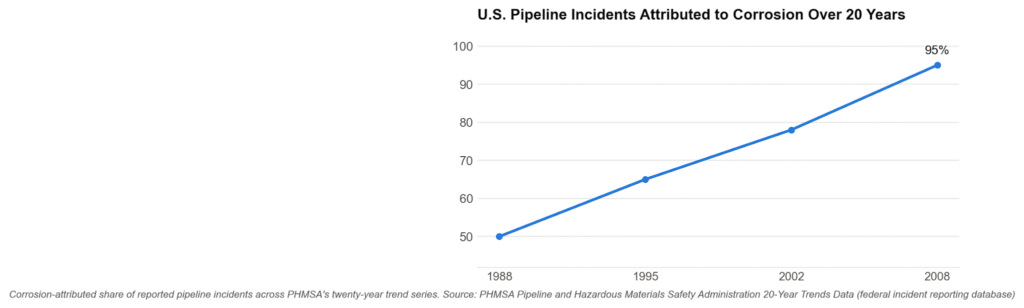
Every operations manager keeps a mental list of the joints that worry him. Searching failure analysis TX twice in one year for the same low spot belongs on that list, and it says the repair program is treating symptoms rather than causes. The record behind the chart is national, but inside a single gathering system the pattern holds: aggressive conditions concentrate somewhere specific, and metal loss follows the water there.
One Leak Costs More Than A Year Of Testing
Run round numbers on one repeat leak on a six-inch flowline, as an illustration rather than a quote. Say the cut-out and re-weld of a twenty-foot spool comes to $22,000 with a rig welder, a vacuum truck, and a crew standing down for most of a day. Add remediation of stained caliche and the soil work behind it, and call that another $18,000 for a small release that never left the right of way. Then there is the paperwork, which costs salary time even when nothing is fineable: somebody writes the incident report, somebody drives out to the landowner, and somebody rebuilds the shut-in schedule for the producers feeding that segment.
Set that against the laboratory work. A scoped investigation on the cut-out spool covers metallography through the pit, deposit and corrosion product identification by X-ray diffraction, electron microscopy of the pit morphology, and chemistry on the water that came out with it. Priced as a scenario, that sits in the single-digit thousands, say $4,000 to $9,000 depending on sample count and turnaround. A year of inhibitor residual sampling and corrosion coupons across forty miles might run $15,000 to $20,000, spread over twelve months and budgeted like any other operating line.
So the second leak, all in, buys two or three years of the monitoring program that would have caught the mechanism before it opened a hole. A leak that repeats is a mechanism nobody has identified yet. The third leak buys the program outright, and it buys a conversation with a regulator that no operator wants on the calendar. That arithmetic is what makes laboratory work look cheap in hindsight and expensive in advance, which is the whole reason it keeps getting deferred.
Root Cause Work Stops The Repeat Leak
The value of a laboratory report is the change it forces upstream of the joint. Under-deposit corrosion in a water-wet sag does not call for a heavier wall. It calls for a pigging frequency that clears the water, an inhibitor that survives the residence time in that line, and a coupon set where the damage happens rather than where the valve is convenient. A July 2026 study in the journal Materials, working in concrete rather than pipe steel, found chloride concentration at the bond interface between new and old concrete runs significantly higher than in the surrounding regions. Different material, same warning for anyone welding a fresh spool into an old line.
None of this makes the leak cheaper after the fact. It makes the next one avoidable, which is the only saving left once crude is on the ground. Cut the spool, keep it dry, send it to a lab that will name the mechanism in writing, and change the program that produced it. Otherwise that sag stays the thing you drive past twice a week, wondering.