
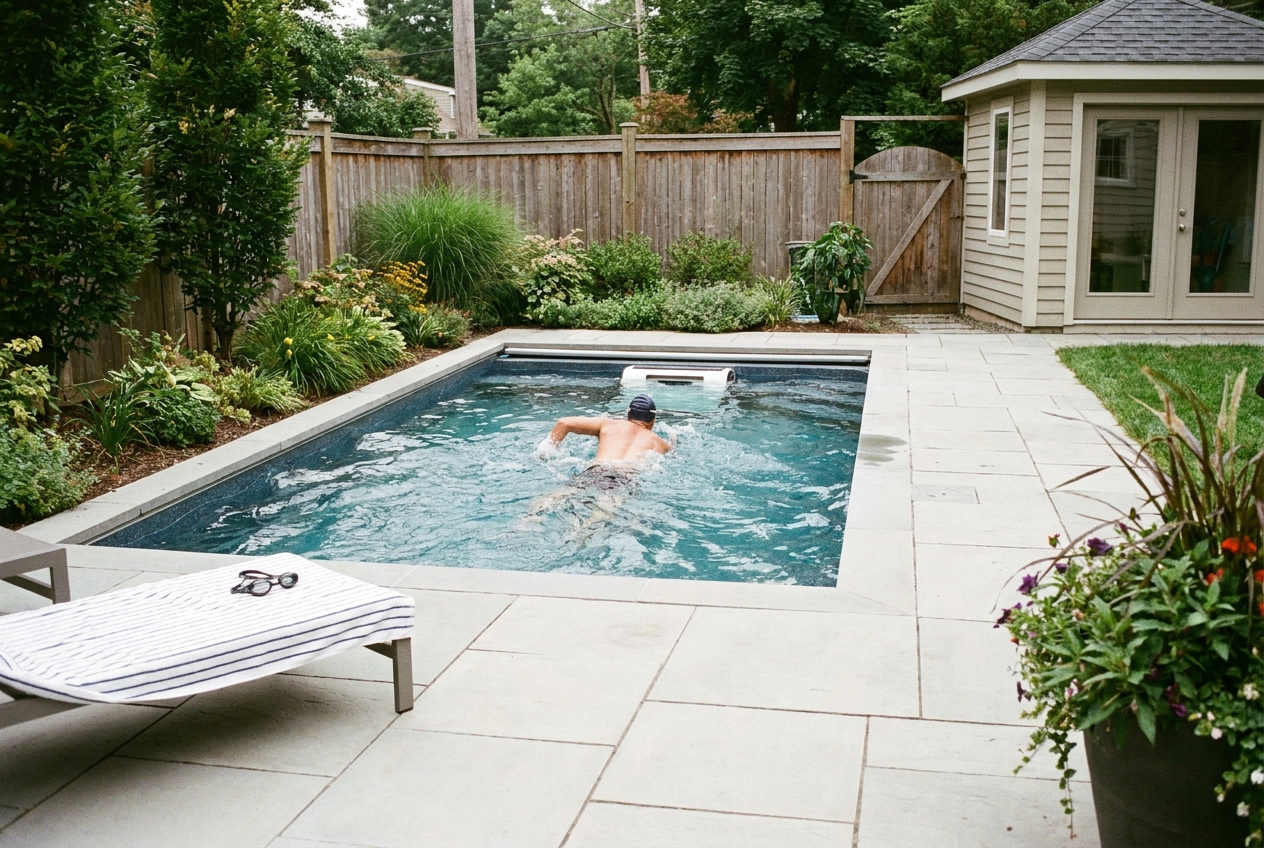

A full lap pool is the dream for many swimmers. It gives you a long, straight lane. You can swim without stopping every few seconds. You can count laps, build endurance, and train with a steady rhythm.
But most homes do not have space for a full lap pool. Many backyard pools are short, curved, or built for relaxing. Some homes have no pool at all. A full lap pool also costs a lot to build and maintain. It may need permits, excavation, plumbing, heating, and a large part of the backyard.
This is why many people look at portable swim machines. These systems are designed to create resistance or moving water in a smaller pool. The swimmer can stay in one place while swimming against the current. In the right setting, this can feel much more useful than turning every few strokes.
So can a portable swim machine replace a full lap pool? The honest answer is: for many home fitness users, yes. For serious race training, not always. The better answer depends on how you swim, how often you train, and what you expect from your pool.
What a Full Lap Pool Does Well
A full lap pool gives you distance. That is its biggest strength. You can swim 25 meters, 25 yards, or more before turning. This helps you build rhythm. It also allows normal lap counting.
For swimmers who train for races, this matters. They need turns, pacing, and distance practice. They may also need lane markings, starting work, and structured sets. A full lap pool can support that better than most small home pools.
A lap pool also feels familiar. Most people learn to swim in long pools. Coaches often plan workouts around distance. For example, a set may include ten 100-yard swims or four 200-meter swims. That structure is easy in a full pool.
But the strength of a lap pool is also its weakness. It needs a lot of space. It is not practical for every home. It may also be more pool than a casual swimmer needs.
What a Portable Swim Machine Does Differently
A portable swim machine changes the goal. Instead of giving you distance, it gives you resistance. You swim against water flow or another type of force. Your body stays in a smaller area, but your effort continues.
This can be useful in a short pool. You do not need to stop at the wall. You do not need to turn again and again. You can swim for time instead of distance. For example, you can swim for five minutes, rest, then repeat.
This style works well for fitness. It can also help with breathing, body position, and stroke control. You can focus on how you move through the water. You can slow down and adjust your stroke.
The experience is not exactly the same as swimming laps. You do not move across a long lane. You do not practice wall turns in the same way. But you can still get a real swim workout.
Space Is the Biggest Difference
A full lap pool needs a long and open area. Even a smaller lap-style pool can take a lot of backyard space. It may limit where you can place furniture, gardens, paths, or outdoor living areas.
A portable swim machine is usually more flexible. It can often work with an existing pool. It can help homeowners use a compact pool for more than play and cooling off.
This is important because many people already have a pool. They do not want to rebuild it. They only want to make it more useful. If the pool has a safe area for swimming in place, a portable setup may be enough.
For homes with limited space, this can be the main reason to choose one. The question is not only “Which is better?” It is also “Which one can actually fit?”
Training for Fitness
For general fitness, a portable swim machine can be a strong option. Most casual swimmers do not need exact race distance. They need regular movement. They need a workout that is easy to start.
Swimming against resistance can raise the heart rate. It can work the arms, legs, core, and back. It can also be gentle on the joints. This makes it useful for people who want low-impact exercise at home.
A simple workout can be based on time. Swim for two minutes, then rest for one minute. Repeat this eight times. Add an easy warm-up and cool-down. This can become a solid session in a small pool.
For many people, this is enough. They are not training for a meet. They want better health, better stamina, and more use from their pool.
Training for Technique
A portable swim machine can also help with technique. Since you stay in one area, it becomes easier to focus on body position. You can think about your head, hips, kick, and breathing.
You can also practice short drills. Work on relaxed breathing. Focus on a long reach. Keep the kick steady. Watch how your body reacts to the current or resistance.
Some swimmers like this because there are fewer distractions. There is no lane traffic. There is no need to turn at the wall. You can repeat a movement again and again.
A full lap pool is still better for practicing turns and race pacing. But a portable system can be very helpful for stroke awareness.
Cost and Commitment
A full lap pool is a major project. It can change the whole backyard. It may also increase long-term maintenance needs. More water means more heating, more cleaning, and more chemical care.
A portable swim machine is usually a lower-commitment choice. It may let you upgrade the use of your current pool without a full build. This can make sense if you are not sure how often you will swim.
Some homeowners compare compact current systems such as igarden jet x air when they want to test whether swim-in-place training fits their lifestyle before thinking about larger backyard changes.
This is a practical way to think about the decision. You do not always need the largest solution. You need the one that fits your real routine.
Family Use Matters Too
A full lap pool is built mainly for swimming. It may not always be the best family pool. It can be long and narrow. It may not leave much room for play, lounging, or other backyard uses.
A portable swim machine can support mixed use. One person can train. Later, the pool can return to normal family use. This is helpful in homes where the pool has many roles.
Children may want to play. Adults may want to relax. One family member may want fitness. A flexible setup can serve more people without making the pool feel like a single-purpose space.
Where a Portable Machine May Not Be Enough
A portable swim machine is not perfect for everyone. Strong swimmers may need a very steady and powerful current. Some systems may not match their pace. They may feel limited if they want high-speed training.
It also may not replace distance training for competitive swimmers. If you need exact 50-meter repeats, race turns, or meet-style pacing, a full lap pool is better.
The pool shape also matters. Some small pools have steps, benches, or shallow areas that reduce usable space. A portable swim machine still needs a safe swimming zone.
Before choosing one, look at your pool carefully. Make sure there is enough room for your arms and legs. Check the depth. Think about how the current or resistance will move through the water.
Which One Should You Choose?
Choose a full lap pool if you have the space, budget, and a strong need for traditional swim training. It is best for serious distance swimming, race practice, and long-term dedicated use.
Choose a portable swim machine if you want to use an existing pool better. It is also a good choice if you want home fitness, technique practice, and steady swimming without a major backyard renovation.
For many casual swimmers, a portable setup can replace the need for a full lap pool. It may not copy the exact experience, but it can solve the main problem. It lets you swim longer in a smaller space.
In the end, the best home swimming setup is the one you will use often. A full lap pool is impressive, but it is not always realistic. A portable swim machine can be more practical. It can turn a normal backyard pool into a useful training space, without asking you to rebuild your whole home around swimming.