
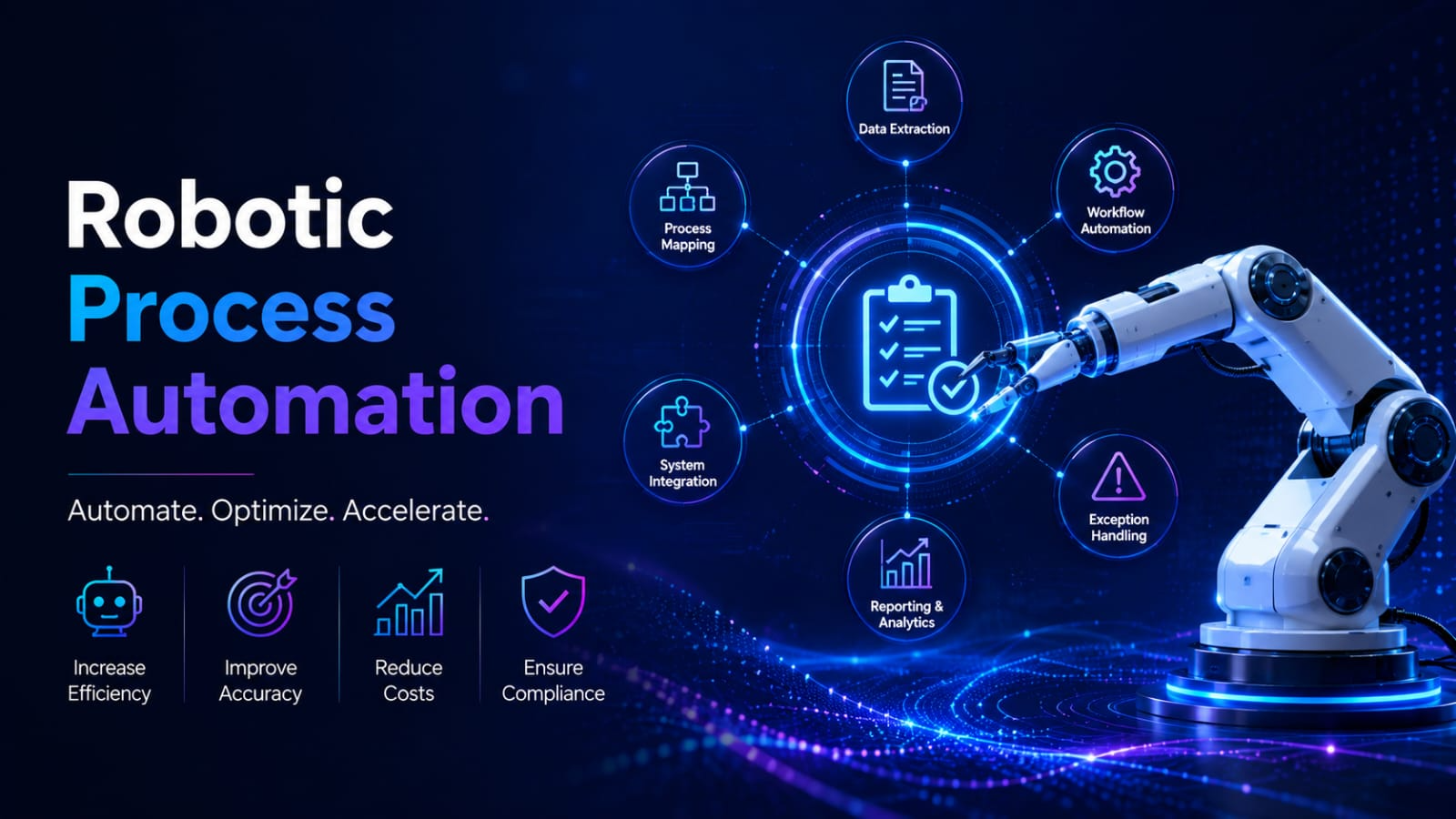

In today’s fast-paced digital landscape, businesses are constantly looking for ways to improve efficiency, reduce operational costs, and eliminate repetitive manual tasks. As organizations scale, routine processes such as data entry, invoice processing, report generation, customer onboarding, and compliance management can consume significant time and resources. This is where Robotic Process Automation (RPA) is revolutionizing modern business operations.
RPA enables organizations to automate repetitive, rule-based tasks using software bots that mimic human actions. These bots can interact with applications, process transactions, manipulate data, generate reports, and perform various administrative functions with speed and accuracy. By automating routine workflows, businesses can improve productivity, reduce errors, and allow employees to focus on higher-value strategic activities.
As digital transformation continues to reshape industries, RPA has emerged as a critical technology for organizations seeking operational excellence and sustainable growth.
What Is Robotic Process Automation (RPA)?
Robotic Process Automation (RPA) is a technology that uses software robots, commonly known as bots, to automate repetitive and rule-based business processes. These bots interact with digital systems in the same way humans do, such as clicking buttons, entering data, copying information, and performing calculations.
Unlike traditional automation solutions that often require extensive system integration, RPA works with existing applications and processes. This makes implementation faster and more cost-effective.
RPA can automate tasks such as:
- Data entry and validation
- Invoice processing
- Payroll management
- Customer onboarding
- Claims processing
- Report generation
- Compliance monitoring
- Email management
By automating these tasks, businesses can significantly improve operational efficiency while reducing manual effort.
Why Are Businesses Adopting RPA?
Organizations across industries are investing in RPA to streamline operations and improve business performance. As competition increases and customer expectations evolve, businesses are looking for ways to optimize processes, reduce costs, and improve service delivery. RPA provides a practical solution by automating routine tasks and enabling employees to focus on higher-value activities.
- Reducing Manual Workloads
Employees often spend hours performing repetitive tasks that add little strategic value. RPA automates these activities, allowing teams to focus on innovation, customer service, and decision-making.
By eliminating time-consuming manual processes, organizations can improve workforce productivity and allocate resources more effectively. Employees can concentrate on tasks that require creativity, problem-solving, and human judgment, leading to greater job satisfaction and business growth.
- Improving Accuracy and Consistency
Human errors in data entry, calculations, and reporting can result in costly mistakes. RPA bots follow predefined rules and execute tasks with a high degree of accuracy.
This reduces the risk of errors and ensures consistent outcomes across business processes. Improved accuracy helps organizations maintain data integrity, comply with regulations, and enhance customer trust through reliable service delivery.
- Enhancing Operational Efficiency
Software bots work continuously without breaks, enabling faster task completion and improved process efficiency. Organizations can process larger volumes of work without increasing workforce requirements.
RPA also reduces process bottlenecks and accelerates turnaround times, allowing businesses to respond more quickly to customer needs and market demands. This leads to higher operational performance and cost savings.
- Supporting Digital Transformation
RPA serves as a foundational technology for digital transformation initiatives by automating workflows and integrating disparate systems. This helps businesses modernize operations and improve agility.
By bridging gaps between legacy and modern applications, RPA enables smoother technology adoption and process innovation. It supports organizations in creating a more connected, data-driven, and scalable digital environment.
How Robotic Process Automation Works?
RPA bots are designed to replicate human interactions with digital systems. They perform tasks based on predefined rules and workflows, enabling organizations to automate routine business operations. By mimicking human actions such as data entry, file processing, and application navigation, RPA helps improve efficiency while reducing manual effort and operational costs.
- Process Identification
The first step involves identifying repetitive, rule-based tasks suitable for automation. Organizations analyze workflows to determine areas where automation can deliver the greatest value.
This assessment helps identify processes that are time-consuming, prone to errors, or require significant manual effort. Prioritizing the right processes ensures successful implementation and maximizes the return on investment from automation initiatives.
- Bot Development
RPA developers create software bots configured to perform specific tasks and workflows. Bots are programmed to interact with applications, databases, and web platforms.
During development, automation logic is defined based on business requirements and process rules. Developers also test bots extensively to ensure they perform tasks accurately, securely, and efficiently across different systems and environments.
- Workflow Automation
The bot executes tasks automatically according to defined business rules and schedules. Automated workflows eliminate manual intervention and improve consistency.
Bots can process large volumes of transactions, transfer data between systems, generate reports, and trigger notifications in real time. This significantly accelerates business processes while maintaining accuracy and compliance with organizational standards.
- Monitoring and Optimization
Organizations continuously monitor bot performance and optimize workflows as business requirements evolve. This ensures long-term efficiency and scalability.
Performance metrics, error rates, and process outcomes are regularly reviewed to identify opportunities for improvement. Continuous optimization helps businesses adapt to changing operational needs and achieve greater value from their RPA investments over time.
Key Features of Robotic Process Automation
Modern RPA platforms include advanced capabilities that extend beyond basic task automation. These platforms help organizations streamline workflows, improve productivity, and enhance operational efficiency. By automating repetitive processes and integrating with existing systems, RPA enables businesses to achieve greater accuracy, scalability, and control over their operations.
- Rule-Based Process Automation
RPA bots operate based on predefined rules and business logic, ensuring tasks are executed consistently and accurately. This capability is ideal for repetitive processes such as data entry, invoice processing, and report generation. Rule-based automation reduces manual effort, minimizes errors, and improves overall process reliability.
- Application Integration
One of the key strengths of RPA is its ability to interact with multiple applications and systems without requiring significant changes to existing infrastructure. Bots can seamlessly transfer data between legacy systems, cloud applications, and enterprise software. This improves connectivity, eliminates data silos, and supports smooth end-to-end business processes.
- Scalability and Flexibility
RPA solutions can easily scale to meet changing business demands. Organizations can deploy additional bots as workloads increase, allowing operations to grow without substantial increases in staffing costs. The flexibility of RPA also enables businesses to modify workflows quickly as processes, regulations, or customer requirements evolve.
- Analytics and Reporting
Modern RPA platforms provide comprehensive analytics and reporting capabilities that help organizations monitor automation performance. Real-time dashboards and detailed reports offer valuable insights into workflow efficiency, bot utilization, and process outcomes. These insights support data-driven decision-making and continuous process improvement.
Types of RPA Solutions
Different types of RPA solutions are designed to address varying business requirements and operational objectives. Organizations can choose the most suitable automation approach based on process complexity, human involvement, and scalability needs. Understanding these RPA types helps businesses implement automation strategies that maximize efficiency and productivity.
- Attended RPA
RPA bots work alongside employees and assist with specific tasks during user interactions. These bots are typically triggered by users and provide real-time support for activities such as data entry, information retrieval, and customer service processes.
By automating repetitive steps within a workflow, attended bots help employees complete tasks more quickly and accurately. This improves productivity, reduces manual effort, and enhances the overall user experience without eliminating the need for human decision-making.
- Unattended RPA
Unattended RPA bots operate independently, executing processes without human intervention. They are designed to run on predefined schedules or respond automatically to specific system events and triggers.
These bots are particularly effective for high-volume, rule-based tasks such as invoice processing, report generation, data migration, and transaction management. By working around the clock, unattended bots increase efficiency, reduce operational costs, and ensure consistent process execution.
- Hybrid RPA
Hybrid RPA combines attended and unattended automation capabilities to create comprehensive workflow solutions. This approach allows businesses to leverage both human expertise and autonomous automation within the same process.
For example, employees can handle customer interactions while unattended bots process background tasks and data updates. Hybrid automation improves collaboration between people and technology, streamlines end-to-end workflows, and maximizes operational efficiency across the organization.
Benefits of Robotic Process Automation
Organizations implementing RPA gain numerous business advantages that contribute to improved efficiency, reduced costs, and enhanced operational performance. By automating repetitive and rule-based tasks, businesses can streamline workflows, increase productivity, and create a more agile work environment. These benefits make RPA a valuable investment for organizations pursuing digital transformation.
- Increased Productivity
Bots work continuously and complete tasks faster than manual processes. This significantly improves operational output.
Unlike human workers, RPA bots can operate 24/7 without breaks, enabling organizations to process larger volumes of work in less time. Faster task completion allows businesses to meet customer demands more effectively and improve overall service delivery.
- Reduced Operational Costs
Automation reduces labor-intensive activities and lowers operational expenses. Businesses achieve greater efficiency with fewer resources.
By minimizing manual effort and reducing the need for additional staffing, organizations can significantly lower operational costs. The savings generated through automation can be redirected toward innovation, business growth, and strategic initiatives.
- Improved Accuracy
RPA eliminates human errors in repetitive tasks and ensures consistent execution. This improves data quality and business reliability.
Bots follow predefined rules with precision, reducing mistakes in data entry, calculations, and reporting. Improved accuracy enhances decision-making, strengthens customer trust, and reduces the costs of error correction.
- Enhanced Compliance
Bots maintain detailed audit trails and execute processes according to established rules. This simplifies compliance management.
Every automated action is recorded and documented, making it easier to meet regulatory requirements and internal governance standards. Organizations can improve transparency, reduce compliance risks, and streamline audit processes.
- Better Employee Experience
Employees can focus on strategic and creative work rather than repetitive administrative tasks. This improves job satisfaction and engagement.
By removing monotonous tasks from daily workloads, RPA allows employees to dedicate more time to problem-solving, innovation, and customer interactions. This creates a more rewarding work environment and supports employee retention and productivity.
Industries Using Robotic Process Automation
RPA is transforming operations across a wide range of industries by automating repetitive tasks, improving efficiency, and reducing operational costs. Organizations are leveraging automation to streamline workflows, enhance customer experiences, and achieve greater accuracy in business processes. As digital transformation accelerates, RPA continues to play a critical role in modernizing industry operations.
- Banking and Financial Services
Financial institutions use RPA for account management, loan processing, fraud detection, and compliance reporting. Automation improves efficiency and regulatory adherence.
By automating routine financial processes, banks can reduce processing times, minimize errors, and improve customer service. RPA also helps organizations manage large volumes of transactions while maintaining strict compliance with industry regulations and security standards.
- Healthcare
Healthcare providers automate patient registration, claims processing, billing, and administrative workflows. This improves patient experiences and operational efficiency.
RPA reduces the administrative burden on healthcare professionals, allowing them to focus more on patient care. Faster processing of records and claims also enhances service quality, reduces delays, and improves overall healthcare operations.
- Retail and E-Commerce
Retail organizations use RPA for inventory management, order processing, and customer support automation. Automation supports scalability and customer satisfaction.
By streamlining back-office and customer-facing operations, retailers can manage high transaction volumes more effectively. Automated processes help ensure accurate inventory tracking, faster order fulfillment, and improved customer experiences.
- Insurance
Insurance companies automate claims processing, policy administration, and customer onboarding. This reduces processing times and operational costs.
RPA enables insurers to handle claims more efficiently while maintaining accuracy and compliance. Automated workflows improve response times, enhance customer service, and allow employees to focus on more complex cases requiring human expertise.
- Manufacturing
Manufacturers use RPA for supply chain management, procurement, and reporting processes. Automation improves productivity and operational visibility.
By automating routine operational tasks, manufacturers can reduce delays, optimize resource utilization, and improve decision-making. RPA also provides greater transparency across production and supply chain activities, supporting better business performance.
RPA and Artificial Intelligence: A Powerful Combination
The integration of RPA and AI creates intelligent automation solutions capable of handling more complex tasks than traditional rule-based automation. While RPA automates repetitive processes, AI adds cognitive capabilities such as learning, reasoning, and decision-making. Together, these technologies enable organizations to automate both structured and unstructured workflows, driving greater efficiency, accuracy, and business value.
- Intelligent Document Processing
AI-powered RPA can extract information from invoices, contracts, forms, and other business documents automatically. This eliminates manual document handling and significantly reduces processing time.
Using technologies such as Optical Character Recognition (OCR) and machine learning, intelligent automation can identify, classify, and validate information from both structured and unstructured documents. This improves data accuracy, accelerates workflows, and enhances operational efficiency.
- Natural Language Processing
Bots can understand and process human language, enabling advanced customer service and communication workflows. Natural Language Processing (NLP) allows automation systems to interpret text, analyze intent, and respond intelligently.
Organizations use NLP-powered bots for customer support, virtual assistants, email management, and chatbot interactions. These capabilities improve customer experiences, provide faster responses, and reduce the workload on support teams.
- Predictive Analytics
AI enhances RPA by providing predictive insights and decision-making support. Organizations can analyze historical and real-time data to identify trends, risks, and opportunities before they impact business operations.
Predictive analytics enables businesses to optimize processes proactively, improve forecasting accuracy, and make more informed decisions. When combined with automation, these insights help organizations increase efficiency, reduce costs, and achieve better business outcomes.
- Intelligent Decision-Making
One of the most significant advantages of combining AI with RPA is the ability to automate decision-based processes. AI algorithms can evaluate data, recognize patterns, and recommend actions based on predefined objectives.
This capability allows organizations to automate more complex workflows that traditionally required human judgment. Intelligent decision-making improves speed, consistency, and scalability while enabling employees to focus on higher-value strategic activities.
Challenges of RPA Implementation
Despite its many benefits, organizations should carefully evaluate the challenges associated with implementing Robotic Process Automation. Successful RPA adoption requires proper planning, process analysis, ongoing management, and employee engagement. Addressing these challenges early helps maximize the effectiveness and long-term value of automation initiatives.
- Process Selection
Not all processes are suitable for automation. Careful evaluation is essential to identify tasks that are repetitive, rule-based, and stable enough for automation.
Organizations must analyze workflows to determine where RPA can deliver the greatest return on investment. Selecting unsuitable or overly complex processes can lead to implementation difficulties, reduced efficiency, and lower automation success rates.
- Change Management
Employees may require training and support to adapt to automated workflows. Introducing automation often changes job responsibilities and existing work processes.
Effective change management helps employees understand the benefits of RPA and encourages acceptance of new technologies. Clear communication, training programs, and stakeholder involvement are critical for ensuring a smooth transition and successful adoption.
- Maintenance and Updates
Bots must be maintained and updated as applications, business processes, and regulatory requirements change over time.
Even minor modifications to software interfaces or workflows can impact bot performance. Regular monitoring, testing, and updates are necessary to ensure automation continues to operate efficiently and deliver expected business outcomes.
- Security Considerations
Organizations must implement robust security controls to protect automated systems and sensitive data. Since bots often access multiple applications and business-critical information, security risks must be carefully managed.
Strong authentication mechanisms, access controls, encryption, and continuous monitoring help safeguard automated processes. Proper security governance ensures compliance with regulations and reduces the risk of data breaches or unauthorized access.
- Scalability and Governance
As automation initiatives expand, organizations must establish governance frameworks to manage bots, workflows, and performance effectively.
Without proper oversight, large-scale automation programs can become difficult to maintain and control. Governance policies help ensure consistency, compliance, risk management, and alignment with business objectives while supporting sustainable growth in automation efforts.
Future of Robotic Process Automation
The future of RPA is being shaped by advancements in artificial intelligence, machine learning, and intelligent automation.
Key trends include:
- Hyperautomation initiatives
- AI-powered decision-making
- Self-learning automation systems
- Intelligent process mining
- Autonomous business operations
- Enhanced cloud-based automation platforms
As these technologies mature, RPA will become even more powerful and capable of handling increasingly complex business processes.
How Moon Technolabs Delivers RPA Solutions?
Moon Technolabs provides end-to-end Robotic Process Automation services that help businesses automate operations, improve efficiency, and reduce costs. Their experienced automation specialists design customized RPA solutions tailored to specific business requirements.
Services include:
- RPA consulting and strategy
- Process assessment and automation planning
- Bot development and deployment
- Intelligent workflow automation
- AI-powered automation solutions
- RPA integration with enterprise systems
- Ongoing support and optimization
Moon Technolabs helps organizations build scalable automation ecosystems that accelerate digital transformation and improve operational performance.
Conclusion
Robotic Process Automation is transforming the way organizations operate by automating repetitive tasks, improving efficiency, and reducing costs. By leveraging software bots and intelligent automation technologies, businesses can streamline workflows, enhance compliance, and improve customer experiences.
As organizations continue to embrace digital transformation, RPA will remain a critical technology for achieving operational excellence and competitive advantage. Partnering with an experienced automation provider like Moon Technolabs ensures successful implementation and long-term business value.