
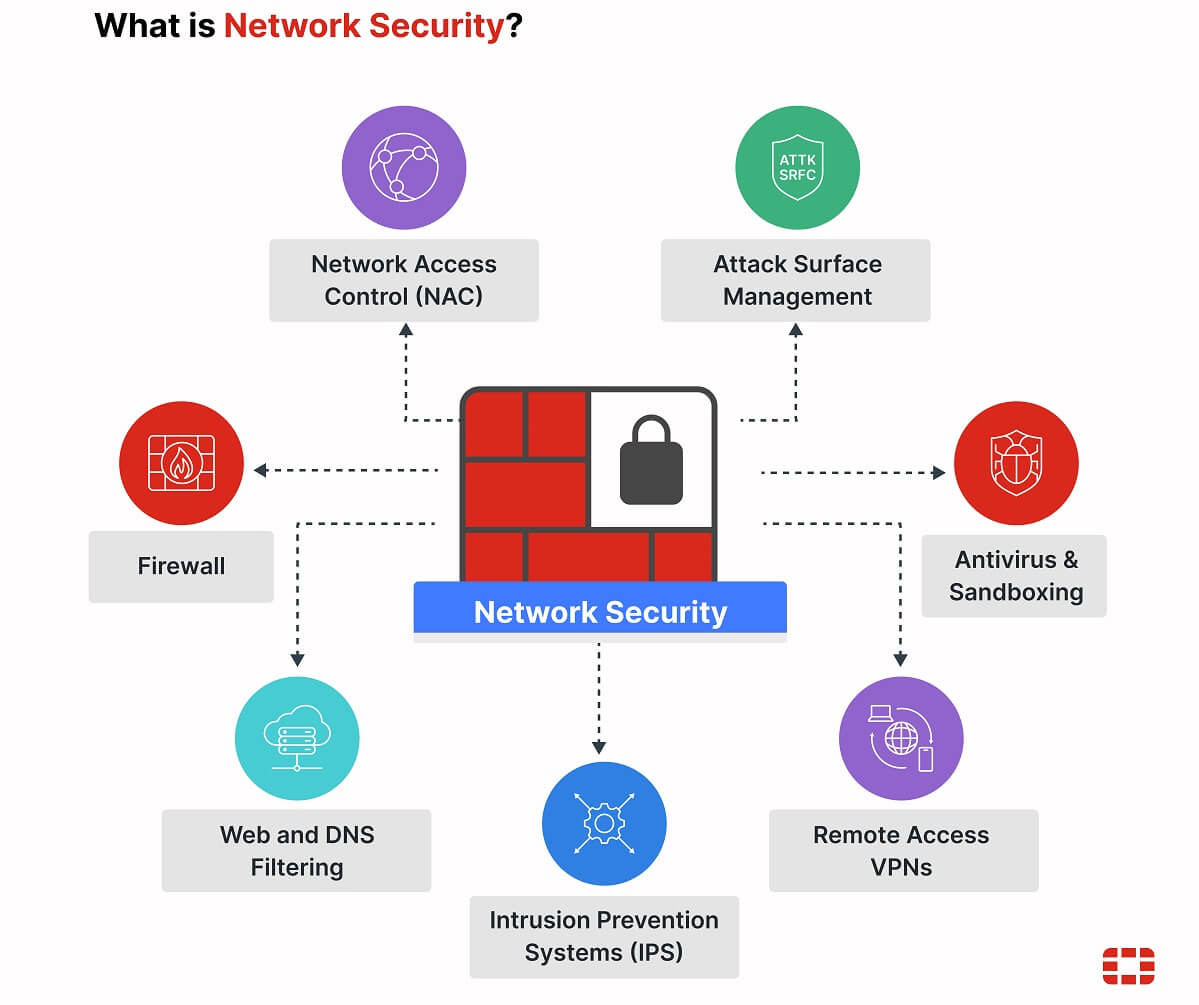

Organizations face network threats from multiple directions at once. Attackers probe perimeters, exploit unpatched systems, target user credentials, and intercept unprotected data. No single security control addresses all of these risks. Effective network security requires a combination of complementary controls, each designed to address a specific category of threat. Understanding the distinct types of network security available helps organizations build defenses that are comprehensive rather than reactive.
Firewall Protection
Firewalls are among the oldest and most widely deployed network security controls. They examine traffic at the network boundary and apply rules to permit or block connections based on source, destination, port, and protocol. Next-generation firewalls extend this capability with application-layer inspection, allowing organizations to enforce policies based on the specific application generating traffic rather than only the port being used.
Deep packet inspection enables firewalls to examine the content of network traffic, not just its headers, which allows for more precise detection of threats that use legitimate ports to move malicious payloads. For organizations operating cloud environments, firewall policy must extend across both on-premises infrastructure and cloud-hosted resources to maintain consistent enforcement.
Intrusion Detection and Prevention
Intrusion detection systems analyze network traffic and system events for patterns that indicate an attack in progress. They generate alerts when anomalous behavior is detected, giving security teams the information they need to investigate. Intrusion prevention systems add the capability to automatically block or disrupt detected attacks, reducing the response time required to contain a threat.
Both system types rely on a combination of signature-based detection, which matches known attack patterns, and behavioral detection, which identifies deviations from established baselines. Behavioral detection is particularly valuable for identifying novel threats that do not match existing signatures. Understanding the types of network security that protect data reveals that intrusion detection serves as an essential layer for catching what perimeter controls miss.
Network Access Control
Network access control governs which users and devices are permitted to connect to the network and under what conditions. Before granting access, these systems evaluate endpoint health by checking for current operating system patches, active antivirus software, and compliance with security policies. Devices that do not meet the defined criteria are placed in a quarantine zone where they cannot reach sensitive systems until remediated.
Research on network segmentation security shows that organizations which implement segmentation across multiple mission-critical areas experience significantly better outcomes when ransomware or lateral movement attacks occur, identifying nearly twice as many incidents compared to organizations with minimal segmentation.
Virtual Private Networks
Virtual private networks create encrypted tunnels between remote users or branch offices and corporate infrastructure. They protect data in transit over public internet connections and allow distributed workforces to access internal resources as if they were directly connected to the corporate network.
Modern deployments often combine VPN access with zero trust principles, requiring identity verification before granting access and limiting what each connection can reach based on role and context. This approach reduces the risk that a compromised VPN connection provides broad access to internal systems.
Email Security
Email remains one of the primary vectors for phishing, malware distribution, and business email compromise attacks. Email security controls include spam filtering, malicious link detection, attachment scanning, and domain authentication protocols such as DMARC, DKIM, and SPF. These controls work together to reduce the volume of malicious messages that reach user inboxes and to prevent attackers from spoofing trusted domains.
Data Loss Prevention
Data loss prevention tools monitor network traffic for patterns that indicate sensitive data is being transferred outside authorized channels. They enforce policies that block or flag transmissions containing regulated information such as financial records, health data, or intellectual property. Implementing data loss prevention requires defining what constitutes sensitive data, mapping where it resides, and establishing rules that match the organization’s acceptable use policies.
Security Information and Event Management
Security information and event management platforms aggregate log data and security events from across the network into a centralized system where they can be correlated and analyzed. This aggregation enables security teams to detect patterns that would not be visible within a single system and to investigate incidents with a complete picture of activity across the environment.
The legal landscape around network security is also evolving. Tracking cybersecurity legal risk priorities has become a core responsibility for security and compliance teams as state and federal regulations continue to expand requirements around security programs, incident disclosure, and third-party risk management.
Frequently Asked Questions
Do small and mid-sized organizations need the same types of network security as large enterprises?
The fundamental types of network security apply across all organization sizes, though the scale and complexity of implementation differ. Small organizations still need firewall protection, access control, and email security. The risk of a breach and its potential impact does not decrease with company size. Attackers frequently target smaller organizations precisely because they are perceived as having weaker defenses.
How does network segmentation reduce the impact of a breach?
Network segmentation creates boundaries within the network that limit how far an attacker can move after gaining initial access. If one segment is compromised, properly configured segmentation prevents the attack from automatically spreading to other parts of the network. This containment capability is one of the most effective ways to reduce the damage caused by ransomware and lateral movement attacks.
What is the relationship between network security and compliance?
Many regulatory frameworks, including those governing healthcare, financial services, and data privacy, require specific network security controls as part of their compliance requirements. Organizations subject to these regulations must implement documented security controls, monitor their effectiveness, and demonstrate compliance through audits. Network security programs that align with regulatory requirements reduce both breach risk and legal exposure simultaneously.